Noorani Qaida Parent Guide
A practical guide to short, positive Noorani Qaida practice at home for children ages 3–12.
How to use this guide
A parent does not need to become the child’s pronunciation examiner. The most useful role is to protect a calm routine, help the child notice the page, replay approved models, and share questions with the teacher.
Use a five-minute routine
Begin with one familiar success, practise one new item, and finish with a game or review. Short, repeatable sessions usually fit a young child’s attention better than occasional long drills.
- One minute of review
- Two minutes on one new skill
- One minute of recognition
- One minute of child choice
Praise the learning behaviour
Praise listening, careful looking, patient retrying, and asking for help. Avoid promising rewards only for perfect pronunciation, because accurate sounds often need gradual teacher correction.
Know when to pause
Stop when the child becomes tense, guesses repeatedly, or loses interest. Record the difficult letter or rule and send it to the teacher rather than turning the session into a test.
See the learning approach
This screenshot documents NoorPath’s learning-platform experience. It is shown for educational and product context. Free playable browser games are linked below separately from the platform screenshots.
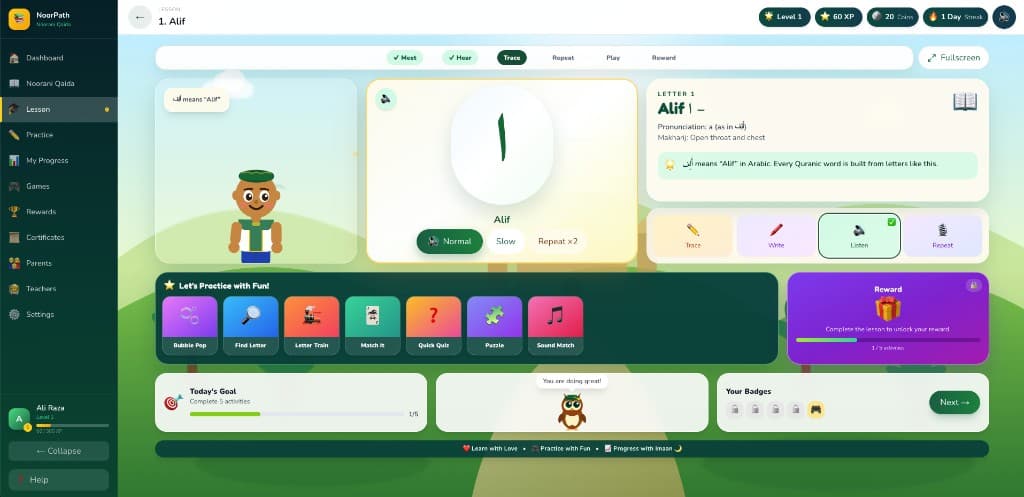
Noorani Qaida Parent Guide checklist
Use the same letter names as the teacher
Keep approved audio available
Practise one contrast at a time
Let the child point before speaking
Share uncertain sounds with the teacher
Frequently asked questions
How long should a young child practise Noorani Qaida?
Start with about five focused minutes and adapt to the child’s readiness. Consistency and calm attention matter more than forcing a fixed duration.
Should parents correct every mistake?
Correct only what the teacher has clearly modelled. Note uncertain articulation for the next lesson instead of reinforcing a guessed sound.
Continue exploring
Want guided Noorani Qaida lessons?
Explore live one-to-one classes for ages 4+, with tutor matching based on learner needs, timezone, and availability.