Listen and notice
Letter names, sound cues, mouth-position guidance, and explicit reminders to seek correction when uncertain.
Use Interactive Noorani Qaida online as a complete 11-module path from the Arabic alphabet to guided Quranic practice. Children can meet, listen, trace, repeat, play and review, while parents and teachers receive practical guidance for the same learning goal.
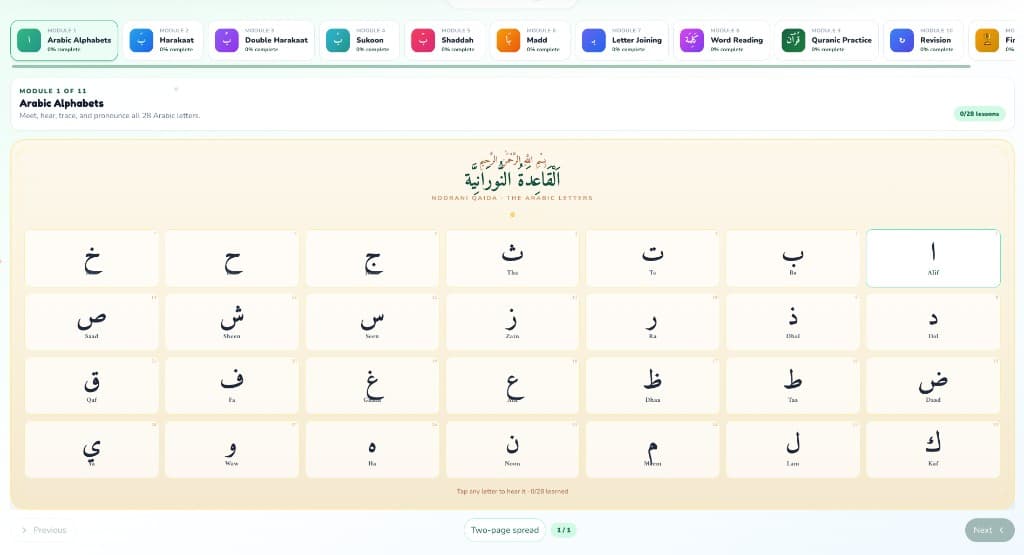
Many search results offer a static PDF, isolated audio clips, or a class enquiry. NoorPath’s educational hub explains what children learn at each stage and how recognition, pronunciation guidance, tracing, games, revision, rewards, parent support and teacher feedback fit together.
Letter names, sound cues, mouth-position guidance, and explicit reminders to seek correction when uncertain.
Games target recognition, sound-symbol matching, memory, sequencing, and fluent recall rather than random tapping.
Parent and teacher notes explain what to model, what to praise, and which errors should be saved for guided correction.
Every module is open for exploration. The sequence still provides a sensible progression for teaching, while learners can revisit or preview any stage.
Meet all 28 letters, their shapes, names, articulation cues, and joining forms.
Module 2 of 11Compare the short sounds of Fatha, Kasra, and Damma.
Module 3 of 11Recognise Fathatain, Kasratain, and Dammatain.
Module 4 of 11Close a consonant cleanly without adding a vowel.
Module 5 of 11Read a doubled consonant as still plus vowelled parts.
Module 6 of 11Learn foundational two-count Alif, Waw, and Ya patterns.
Module 7 of 11Compare isolated, initial, medial, and final forms.
Module 8 of 11Blend signs and joined forms into short words.
Module 9 of 11Apply familiar reading clues to guided words and phrases.
Module 10 of 11Mix recognition, pronunciation, joining, and reading practice.
Module 11 of 11Review with parent and teacher guidance before the next reading stage.
Open any letter to compare its four forms, articulation cue, example, common confusion, writing direction, and age-appropriate home and classroom practice.
Fatha is a short diagonal mark above a letter that gives a brief a sound.
كَسْرَةKasra is written below a letter and gives a brief i sound.
ضَمَّةDamma is a small curl above a letter that gives a brief u sound.
فَتْحَتَانTwo Fatha marks add a light an ending.
كَسْرَتَانTwo Kasra marks add a light in ending.
ضَمَّتَانDammatain combines a short rounded u with a light n ending.
سُكُونSukoon shows that a consonant has no vowel after it.
شَدَّةShaddah makes one written consonant function like two joined consonants.
مَدُّ الأَلِفFatha followed by a suitable Alif produces a long ā sound.
مَدُّ الوَاوDamma followed by a suitable silent Waw produces a long ū sound.
مَدُّ اليَاءKasra followed by a suitable silent Ya produces a long ī sound.
وَصْلُ الحُرُوفArabic letters can change shape at the beginning, middle, and end of a word.
قِرَاءَةُ الكَلِمَاتBlend two- to five-letter words by reading signs and joined forms from right to left.
تَدْرِيبٌ قُرْآنِيّApply familiar reading rules to carefully selected Quranic words and short phrases.
الحُرُوفُ المُقَطَّعَةMuqatta'at letters are special opening letters found at the beginning of some Quranic surahs.
الحَرَكَاتُ مَعَ التَّنْوِينMixed practice asks the learner to connect letters while reading short vowels and Tanween accurately.
الحَرَكَاتُ القَائِمَةStanding Fatha, standing Kasra, and standing Damma indicate a stretched vowel sound.
حُرُوفُ المَدِّ وَاللِّينMadd letters are lengthened with matching vowels, while Leen letters are read softly after Fatha.
أَسْبَابُ المَدّHamza, Sukoon, and stopping can change how long a Madd is held.
تَدْرِيبُ السُّكُونِ وَالجَزْمSukoon exercises train learners to close consonants cleanly and distinguish similar sounds.
تَدْرِيبُ الشَّدَّةShaddah exercises strengthen doubled letters and the special nasal quality on Meem and Noon.
الشَّدَّةُ مَعَ السُّكُونThis stage combines doubled letters with nearby still letters in longer reading phrases.
الشَّدَّةُ مَعَ الشَّدَّةTwo Shaddah signs in a phrase require controlled doubling without rushing.
الشَّدَّةُ مَعَ حُرُوفِ المَدّThis lesson connects doubled letters with Madd letters in longer Quranic practice phrases.
These pages build terminology and recognition. They do not claim certification or replace listening to reviewed recitation and receiving teacher feedback.
Makharij are the places from which Arabic letter sounds emerge.
النُّونُ السَّاكِنَةُ وَالتَّنْوِينThe sound of a still Noon or Tanween changes according to the following letter.
المِيمُ السَّاكِنَةA still Meem is read according to the letter that follows it.
المَدّMadd governs the measured lengthening of specific vowel sounds.
القَلْقَلَةQalqalah is a controlled echo-like release on ق ط ب ج د when they carry Sukoon.
الغُنَّةGhunnah is a measured nasal quality associated especially with Noon and Meem.
الوَقْفُ وَالابْتِدَاءWaqf concerns where and how a reciter stops, while Ibtida concerns where reading resumes.
Play letter matching, a harakat quiz, and a parent progress checklist on your phone. No account is required. These activities reinforce recognition after a clear model.
Find the matching Arabic letter name from a small set of choices.
Play nowRecognise Fatha, Kasra, and Damma on simple Arabic letters.
Play nowTick what your child has covered and share a simple progress card.
Play nowPrefer teaching guidance first? Read the Noorani Qaida games guide or open the free games hub.
Know another parent teaching their child Noorani Qaida? Share this free resource with them.
Every public guide and free games hub in this cluster — reach any URL in one or two clicks from this hub. Commercial live classes stay on the course and kids class pages.
A practical guide to short, positive Noorani Qaida practice at home for children ages 3–12.
Open guideA lesson-planning framework for recognition, modelling, guided practice, games, and review.
Open guideA structured listen, recognise, trace, repeat, play, and review routine for beginner Quranic Arabic.
Open guideHow NoorPath’s letter games turn recognition, listening, sequencing, and recall into focused practice — plus free playable browser games.
Open guideNoorani Qaida pronunciation for English-speaking families: letter names vs reading sounds, makharij cues, transliteration limits, and when to use a teacher.
Open guideNoorani Qaida PDF vs interactive learning: judge print files wisely, use digital drills for recognition, and combine both without unlicensed downloads.
Open guideLearn what Noorani Qaida with animation should mean for kids: visual lessons, purposeful motion, and NoorPath’s preview video plus interactive letter practice.
Open guideGamified Quran learning for kids explained: useful game design, free NoorPath letter and harakat games, and how to avoid reward traps that skip foundations.
Open guideOnline Arabic alphabet practice for kids: recognition-first routines, 28 NoorPath letter pages, find-the-letter practice, and free matching games on mobile.
Open guideNoorani Qaida with audio—honest guidance: evaluate recordings, avoid guessed sounds, and see what NoorPath offers before a full Qari-reviewed library ships.
Open guideDigital Quran learning platform guide: digital vs traditional, what to inspect, and how NoorPath separates interactive Qaida, free games, and live lessons.
Open guideIt is NoorPath’s structured Interactive Noorani Qaida online learning-platform experience for ages 3–12. The 11-module journey covers Arabic letters, short and double vowels, Sukoon, Shaddah, Madd, joining, word reading, guided Quranic practice, revision, and review.
Yes. The public hub, letter pages, and free browser games can be opened without an account. Live one-to-one classes are a separate enrolment path with tutor matching.
No. It supports recognition, guided practice, replay, tracing, games, and progress. A qualified teacher or approved recitation remains important for correcting uncertain pronunciation and Tajweed.
No. Learners can open modules and lessons freely. Progress, stars, badges, and rewards acknowledge activity without blocking curriculum access.
The English-language platform can support families worldwide. Live classes for ages 4+ are arranged separately through NoorPath’s existing timezone-based tutor-matching process.
NoorPath does not currently publish a licensed PDF download. The PDF comparison guide explains how to evaluate authorised resources and combine print with interactive practice.
Free tools on this hub help with recognition between lessons. When you want a teacher to correct sounds live, request Qaida lessons with UK schedule matching, Noorani Qaida online for USA families, or live Qaida with New Zealand timezone matching. Availability is confirmed after your trial request.
Explore live one-to-one classes for ages 4+, with tutor matching based on learner needs, timezone, and availability.
NoorPath uses essential storage for your preferences. With your permission, we also use Google and Meta tools to understand visits and measure enquiries. Read our Privacy Policy.