Noorani Qaida Practice Guide
A structured listen, recognise, trace, repeat, play, and review routine for beginner Quranic Arabic.
How to use this guide
Effective practice changes the task instead of repeating one response indefinitely. NoorPath’s cycle moves from seeing and hearing to recalling and applying, with brief review spaced across later sessions.
Recognise before producing
Ask the learner to point to the target letter or mark before saying it. Recognition isolates visual understanding and reduces the pressure of doing everything at once.
Trace for attention, not proof
Tracing can focus the eyes on shape direction and dots, but a neat trace does not prove recognition or pronunciation. Follow it with a choice or reading prompt.
Retrieve through mixed practice
After a correct model, mix the target with a small number of familiar distractors. Return to it later in the session and again on another day.
- Target plus two familiar items
- One immediate retry
- One delayed review
- One new context
See the learning approach
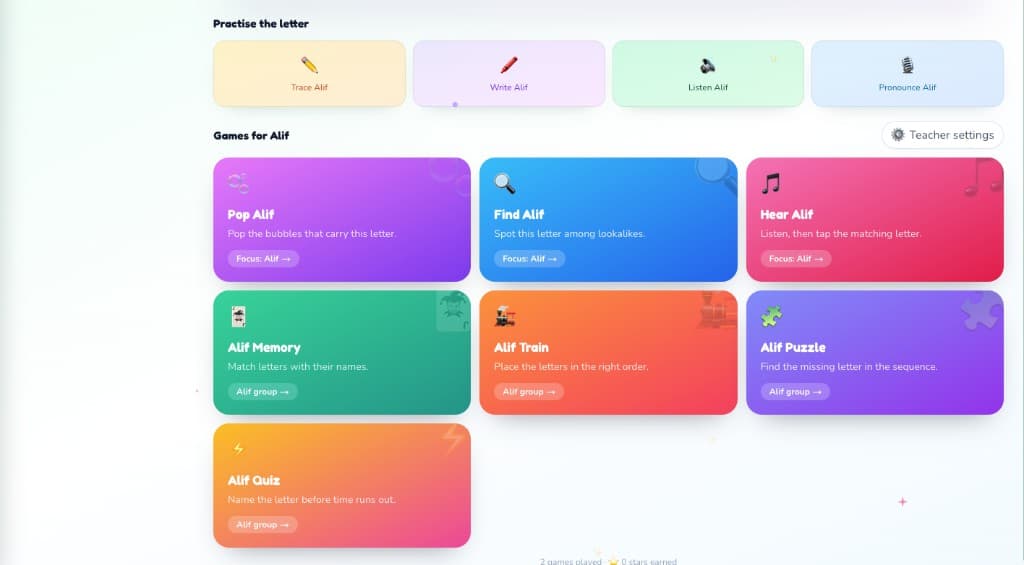
This screenshot documents NoorPath’s learning-platform experience. It is shown for educational and product context. Free playable browser games are linked below separately from the platform screenshots.
Noorani Qaida Practice Guide checklist
Choose one target
Limit distractors
Keep vowels short where required
Record difficult contrasts
Finish with a known success
Frequently asked questions
Is daily practice necessary?
A short, regular routine can support retention, but families should choose a sustainable schedule and follow the teacher’s priorities.
How many new letters should a child practise?
Use a small number based on readiness. Mixing one new target with familiar letters is often more informative than presenting many new shapes.
Continue exploring
Want guided Noorani Qaida lessons?
Explore live one-to-one classes for ages 4+, with tutor matching based on learner needs, timezone, and availability.