What does Noon look like?
A bowl with one dot above; medial Noon resembles the Baa family. Find Noon ن, name its dots, and point to the part of the shape that stays familiar when it joins.
Noon is easy to confuse in joined text because its medial form resembles the Baa-family bowl. The single upper dot is the reliable clue. Teach recognition in isolation first, then in medial position next to Baa, Taa, and Thaa so the child tracks dots rather than guessing from word meaning.
How to approach the Noon sound
The compact transliteration cue is “Noon”, but transliteration cannot reproduce every Arabic sound. The physical orientation for this letter is: Tongue tip meets the gum ridge with nasal resonance. Listen to an approved model and ask a teacher to verify uncertain attempts.
Noon examples
Practise writing and finding Noon
Start with the main Noon shape, write from right to left, then add any dots only after the body is clear.
Name Noon’s single upper dot before saying the sound.
Compare نـ with بـ and تـ in a short three-letter row.
Trace the Noon bowl, then place the dot above.
Find Noon in نَجْم and in one medial ـنـ example.
Play a find-Noon round among two Baa-family distractors.
Find Noon among nearby letters
Tap the matching letter. This checks visual recognition only — it does not grade pronunciation.
Find Noon
How an interactive letter lesson is organised
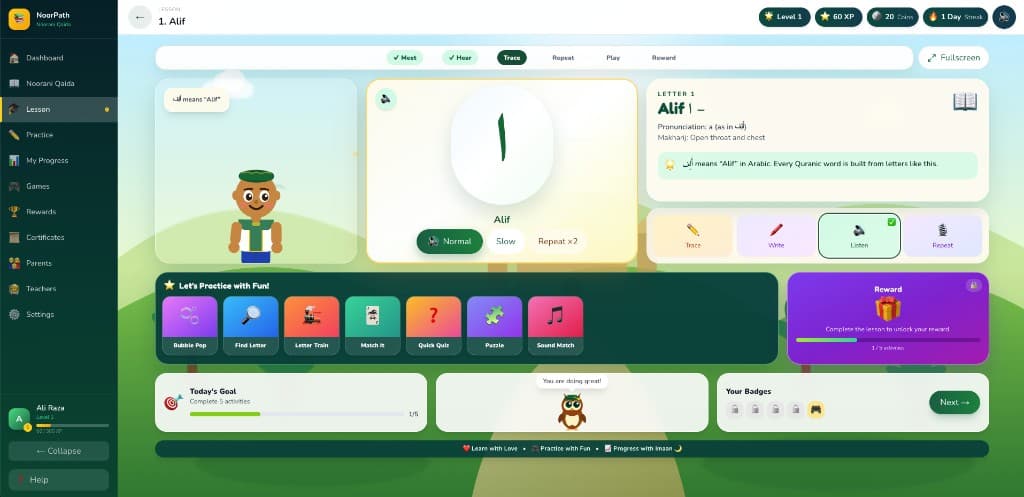
The NoorPath platform separates meeting the letter, hearing a model, tracing, repeating, playing, and reviewing. Rewards record activity; they do not lock other letters or modules.
Parent and teacher guidance
Frequently asked questions
How is the Arabic letter Noon pronounced?
Noon is represented here as “Noon”. Its articulation cue is: Tongue tip meets the gum ridge with nasal resonance. English spelling is only an approximation, so use an approved audible model or teacher correction for accuracy.
What are the four forms of Noon?
The isolated, initial, medial, and final teaching forms shown on this page are ن، نـ، ـنـ، ـن. The exact form used depends on position and whether neighbouring letters connect.
What can children confuse with Noon?
Track the single upper dot and do not confuse Noon with Baa in joined text.
Continue learning after Noon
Want a teacher to guide Noon pronunciation?
Explore live one-to-one classes for ages 4+, with tutor matching based on learner needs, timezone, and availability.