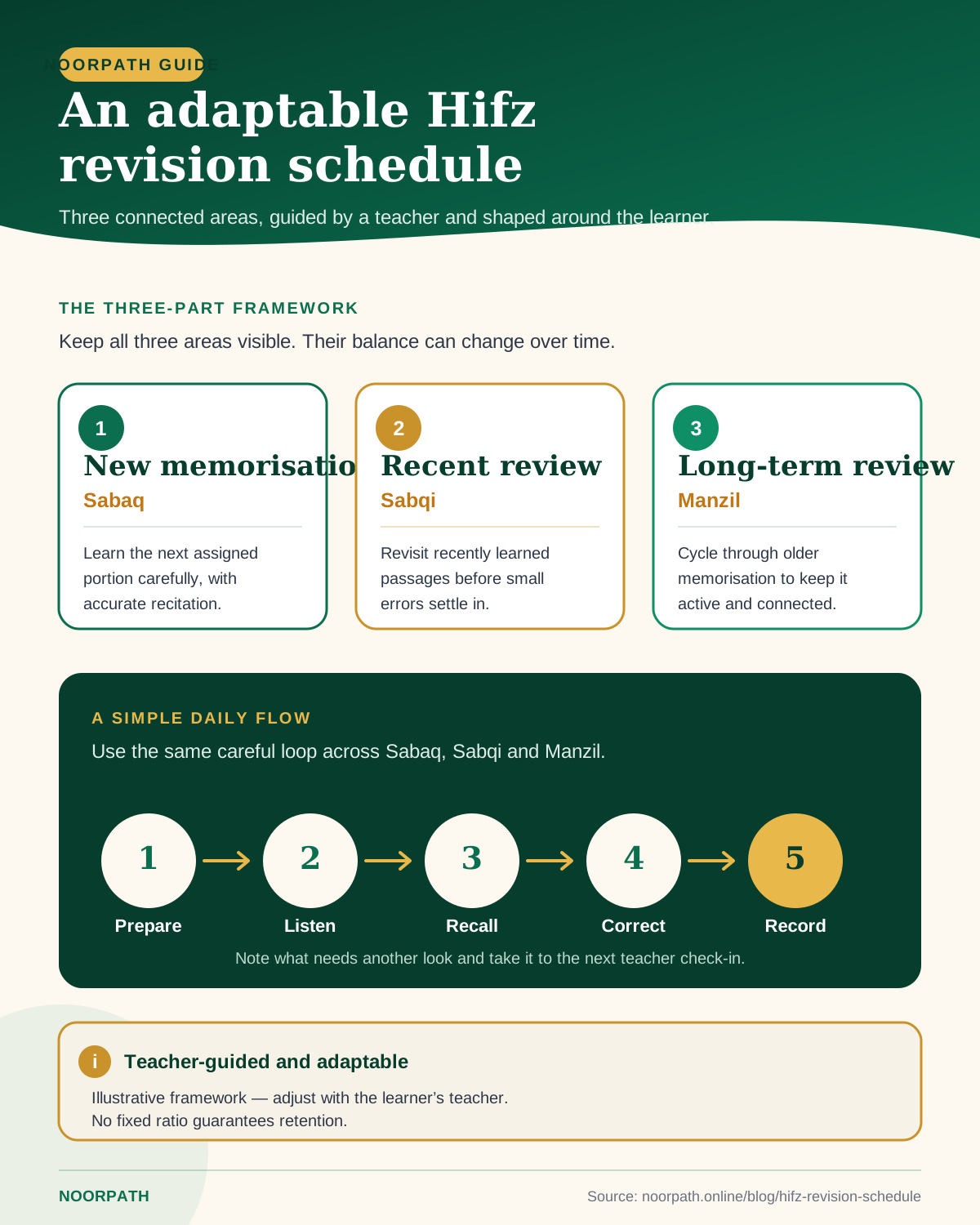
The central principle is more important than the names: new learning should not consume the time needed to keep earlier learning available and accurate. A learner who can present today’s passage but repeatedly loses last month’s work does not primarily need a more ambitious new target. The schedule needs rebalancing. Equally, a learner who has a secure older rotation may be ready for a modest increase only after the teacher has listened and agreed.
| Planning lane | Purpose | Useful evidence | Adjustment signal |
|---|
| Sabaq: new | Build an accurate first memorisation of a small assigned passage. | The learner can recite to the teacher without relying on avoidable prompts and can respond to correction. | Pause or reduce the new amount when errors multiply, preparation is rushed or revision is displaced. |
| Sabqi: recent | Strengthen material that is no longer today’s lesson but is not yet dependable. | Recent passages can be retrieved in varied order with fewer hesitations and recurring corrections. | Keep material here longer when it only works from a familiar starting point or after a prompt. |
| Manzil: older | Maintain older memorisation through a realistic rotation. | Previously learned portions remain available across the rotation, with errors logged and repaired. | Shorten the rotation or reduce new work when older portions show widening gaps. |
A practical planning framework
1. Establish an listened-to baseline
Before choosing quantities, ask the teacher to listen to representative new, recent and older material. Record concrete observations: where prompting was needed, whether similar verses were confused, which pronunciation or Tajweed corrections recur, and whether the learner can begin from a point selected by the teacher. Do not turn one difficult sitting into a permanent judgement. The baseline simply identifies what the next schedule must protect.
Also record constraints that genuinely affect the plan: lesson days, school or work demands, sleep, caring responsibilities, health, travel, and the amount of quiet practice time that is reliably available. A nominal one-hour block is not useful if it rarely exists. Prefer a smaller repeatable commitment to an impressive schedule that repeatedly collapses.
2. Set revision before new memorisation
Reserve realistic periods for recent and older review first. Then decide, with the teacher, how much new material can be prepared accurately in the time left. This order is a safeguard, not a claim that every session must literally begin with Manzil. Some learners concentrate best on new work early; others benefit from warming up with familiar recitation. The teacher can choose the sequence while preserving all three functions.
Use ranges rather than pretending that every page has equal difficulty. A short passage with unfamiliar vocabulary, similar endings or persistent articulation problems may require more work than a longer familiar passage. Progress is not fairly measured by page count alone. Accuracy, independence, stability after a delay and the teacher’s judgement all matter.
3. Prepare Sabaq for accuracy
Confirm the assigned text and the reading convention used in lessons. Listen to an appropriate model if the teacher recommends one, follow the text carefully, and divide the assignment into meaningful small units. Read each unit accurately before trying to recite it from memory. Connect neighbouring units gradually, then test the whole assignment without staring at the page. Mark the exact places that fail instead of restarting mechanically every time.
Self-testing is useful because recognition can feel stronger than unaided recall. However, self-testing does not validate pronunciation. The learner may confidently reproduce an unnoticed error. New work therefore needs live listening and correction from a suitable teacher, especially when the learner cannot reliably distinguish the target sound or rule.
4. Keep Sabqi genuinely active
Recent review should test access, not merely repeat a comfortable run. The teacher might ask for a different starting point, connect the end of one passage to the next, or revisit a previously corrected location. At home, alternate supported checking with closed-text recall. If a passage repeatedly fails, narrow the repair task: identify the unstable line or transition, compare it carefully with the text, practise the corrected form, reconnect it to the surrounding passage, and present it again.
A passage should not move into the older rotation merely because a calendar interval has passed. Movement depends on the teacher’s criteria and the learner’s performance. Some material needs a longer period of frequent review. Keeping it in Sabqi is not failure; it is a planning response to evidence.
5. Run Manzil as a recoverable rotation
Divide older memorisation into units that can be reviewed across the available days. The units need not be equal if some are less secure. Track what was actually recited rather than what the planner intended. If a day is missed, avoid doubling work automatically when that would produce hurried recitation. Resume through a teacher-agreed recovery rule: carry over a manageable portion, temporarily reduce new work, or extend the rotation.
Build error repair into Manzil. A rotation that repeatedly passes over the same errors can rehearse them. Keep a concise log with the passage location, type of issue, teacher’s correction and date checked again. The log should guide attention, not become a burdensome scoring system. Remove or archive an item after the teacher confirms that the correction is stable enough for normal review.
6. Review the schedule, not just the learner
At an agreed checkpoint, ask: Is the new assignment usually prepared without rushing? Is recent material becoming more independent? Is the older rotation being completed at an acceptable standard? Which recurring errors need direct teaching? Are missed sessions caused by motivation, unrealistic volume, unclear instructions or changing circumstances? Alter one or two variables, then observe. Changing everything at once makes it difficult to know what helped.
Example weekly pattern to adapt with a teacher
| Session type | Sabaq | Sabqi | Manzil | Record |
|---|
| Teaching day | Present the assigned new passage and receive correction. | Present selected recent material, including weak transitions. | Recite the scheduled older unit or a teacher-selected sample. | Next assignment, corrections and any changed priority. |
| Independent practice day | Prepare only the agreed amount; check against the text. | Retrieve recent passages, varying the starting point where appropriate. | Continue the rotation at a sustainable pace. | Actual completion and places to ask about. |
| Consolidation day | No new material, or a reduced amount if the teacher approves. | Repair unstable recent passages. | Catch up safely or revisit a weak older unit. | What improved and what still needs listening. |
| Review checkpoint | Confirm whether the new pace remains suitable. | Decide which material remains recent. | Check rotation length and recurring errors. | One clear adjustment for the next period. |
This is a pattern, not a prescription. It deliberately gives no universal number of pages, repetitions or hours. Those figures would be misleading without knowing the learner, the portion, current accuracy and the teacher’s method. Children and adults may both need short sessions or breaks, but age alone does not determine capacity. A teacher who hears the learner is better placed to set and revise the workload.
How to respond when the schedule slips
First separate a one-off interruption from a repeated design problem. Illness, travel or an unusually demanding week may call for a temporary recovery plan. Repeatedly unfinished Manzil, rushed Sabaq or the same uncorrected errors suggest that the normal schedule is overloaded or unclear. Tell the teacher what was completed accurately; do not conceal gaps by rushing through them immediately before a lesson.
- Protect correctness. Avoid increasing speed simply to clear a backlog.
- Preserve continuity. Keep a manageable contact with the material where circumstances allow.
- Reduce selectively. The teacher may pause new memorisation, narrow the recent set or extend the older rotation.
- Repair specifically. Work on named passages and transitions rather than declaring the whole memorisation weak.
- Restart visibly. Record the revised point in the rotation so omitted sections do not disappear.
Make checkpoints useful without turning them into guarantees
A checkpoint should produce a teaching decision, not merely a total. Agree in advance what the teacher will sample and what the result can change. For example, the teacher may listen to the current Sabaq, select recent passages without following the learner’s usual order, and sample more than one place from the older rotation. This can reveal whether a difficulty belongs to one passage, a transition, a recurring recitation feature or an overloaded schedule. It does not calculate a permanent ability level.
Use plain records that another responsible adult or teacher can understand: assigned portion, material actually presented, prompts or corrections that mattered, and the next action. A streak, percentage or colour code may be motivating for some learners, but it should never hide the quality of recitation or encourage a child to rush for a badge. Avoid comparing page totals between learners. They may be working with different starting points, methods, passages, lesson frequency and correction needs.
Ask the teacher to distinguish a temporary lapse from a pattern before changing the whole plan. If one older section was weak after an interruption, a focused repair may be enough. If weaknesses appear throughout the rotation, new memorisation may need to pause while revision is rebuilt. The checkpoint is successful when it leads to a specific, sustainable response and makes the next review clearer. It is not a forecast of completion, a ranking, or evidence that future retention is assured.
Using general learning research responsibly
Research on learning commonly discusses spaced practice and retrieval: revisiting learning across time and attempting to recall it rather than relying only on restudy. A broad review in Nature Reviews Psychology, DOI: 10.1038/s44159-022-00089-1, examines spacing and retrieval practice across learning research. An ERIC-indexed meta-analysis, EJ1310148, addresses spaced practice and retrieval practice in educational contexts.
This general learning evidence is not Quran-specific proof. It does not establish a universal Hifz schedule, a guaranteed retention outcome, an ideal number of repetitions or the religious and pedagogical requirements of Quran recitation. Quran memorisation includes accurate oral transmission, pronunciation, Tajweed, teacher correction, meaning and individual spiritual practice that cannot be reduced to findings from general learning tasks. The research offers cautious planning ideas; it does not override a suitable teacher’s listening-based judgement.
A reasonable application is therefore modest: distribute revision rather than leaving all review to one late block; include opportunities for genuine recall; revisit errors after correction; and review the plan using observed performance. Even these applications must be adjusted with the teacher. If recall practice causes persistent inaccurate recitation, more unsupported recall is not automatically better; the learner may need modelling, text-supported repair and live feedback first.
Limitations and safeguards
- This resource is an organisational aid, not a fatwa, curriculum, assessment, medical recommendation or guarantee of memorisation.
- It cannot hear the learner, verify recitation, identify every cause of difficulty or choose a suitable daily quantity.
- Terminology and teaching practice differ. Sabaq, Sabqi and Manzil are used here as adaptable categories only.
- Schedules should accommodate disability, illness, fatigue, neurodiversity and family circumstances without making unsupported clinical assumptions.
- Where a learner experiences pain, significant distress or a health concern, seek appropriate professional support; a memorisation planner is not healthcare.
- No schedule prevents forgetting. Revision needs may change by passage, life stage, interruption and teacher assessment.
Source and method note
This guide was created as a practical interpretation of the three-lane structure shown in the infographic. It separates descriptive planning advice from research claims, links directly to the two requested research records, and states the limits of applying general learning literature to Hifz. It does not derive numerical targets from those sources. Recommendations are deliberately conditional because neither source evaluates this exact infographic or proves one Quran memorisation timetable. Content should be reviewed alongside the learner’s teacher and the text, recitation convention and method used in lessons.
How to cite or embed the infographic
You may link to this page or embed the SVG in a relevant educational article. Keep the image unaltered, use meaningful alternative text, place it near explanatory context, and credit “NoorPath — Hifz Revision Schedule” with a link to the original resource page. Do not use the graphic to imply guaranteed results, research endorsement, or that NoorPath or the cited authors approved a modified schedule. If your platform cannot display SVG safely, link to the download instead of removing attribution or accessibility text.
Suggested citation: NoorPath. “Hifz Revision Schedule.” Updated 15 July 2026. /resources/hifz-revision-schedule. For academic work, follow the required citation style and cite the underlying research directly for claims about general learning.
Related guidance