“Suitable teacher” here means someone appropriate to the learner and the requested subject who can demonstrate, listen, distinguish the relevant feature and explain a manageable correction. This guide does not list or imply unsupported certifications. Ask a provider or teacher what relevant study, teaching experience and assessment process supports the proposed instruction, and judge the answer in context. A title alone does not let this page verify teaching quality.
Start with an observable description
Avoid beginning with “my Tajweed is bad” or “I cannot pronounce Arabic”. These broad labels hide the next action. Instead, bring a short example: the exact word and verse location, what usually happens, whether it changes in connected recitation, and whether the difficulty remains after the teacher models it. If possible, note whether the issue appears in every occurrence or only near particular vowels, sukun, shaddah, stopping or neighbouring letters.
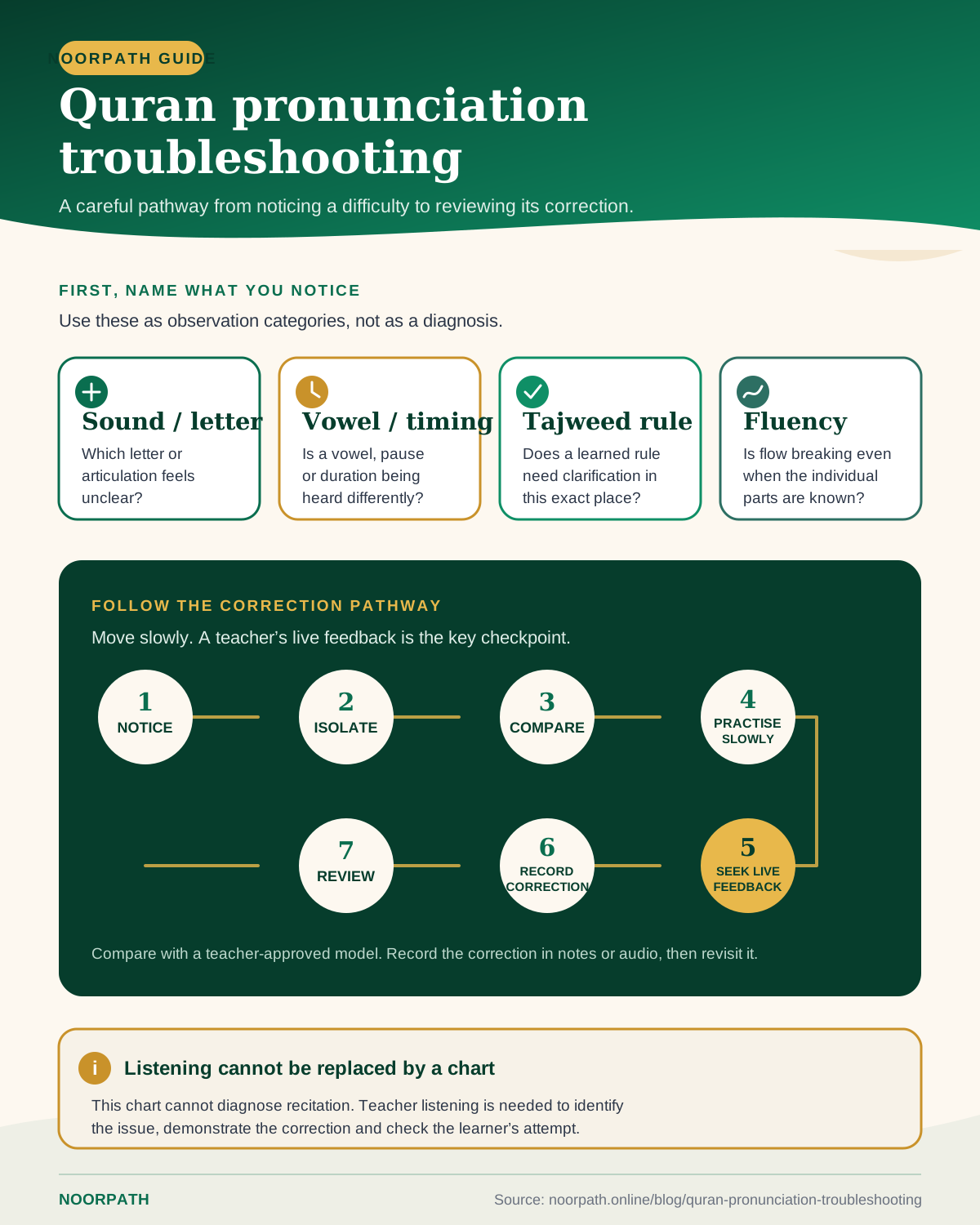
Do not decide the cause before the teacher listens. A learner may think a letter’s articulation point is the sole issue when the audible difference comes from timing, vowel quality, voicing, pressure, nasalisation, a neighbouring sound, stopping, microphone distortion or an unstable reading foundation. The flow deliberately moves from observation to feedback rather than from symptom to self-diagnosis.
| What you notice | First check | Useful next step | Do not conclude |
|---|
| The model and learner sound different. | Confirm the exact text, reading convention and a clear model approved by the teacher. | Ask the teacher to name one audible priority and demonstrate the contrast. | That replaying the recording alone will reveal or correct the cause. |
| The sound works alone but changes in a word. | Check the vowel, neighbouring letters, joining and recitation speed. | Practise a short progression from sound to syllable, word and phrase under feedback. | That the isolated sound proves correct connected recitation. |
| The correction works in the lesson but disappears later. | Check whether the learner can recognise the target and recall the teacher’s cue. | Use brief distributed practice and return with the same examples for listening. | That more speed or many new rules will stabilise it. |
| Online sound seems unclear or inconsistent. | Test microphone placement, echo, connection and headphones with actual recitation. | Improve audio or arrange another reliable listening method before fine correction. | That every difference comes from the learner. |
| Several difficulties appear at once. | Ask which error most affects the current learning objective. | Prioritise one or a small related group, then reassess. | That every issue should be corrected simultaneously. |
The LISTEN troubleshooting framework
L — Locate one repeatable example
Select the shortest example that still contains the difficulty. Keep the Arabic text available and record the surah and verse rather than relying on transliteration. Transliteration systems cannot represent every relevant contrast consistently and may encourage an approximation shaped by English spelling. If the learner is not yet secure in recognising Arabic letters and vowel signs, that foundation may need teaching alongside pronunciation rather than being bypassed.
Try the item in three contexts only if the teacher considers this appropriate: the sound or feature in isolation, inside the word, and in a short connected phrase. The aim is not to perform an amateur examination. It is to show the teacher where the output changes and reduce unnecessary repetition of a larger passage.
I — Inspect the learning conditions
Confirm that the learner is looking at the correct text and following the recitation convention used by the teacher. Check whether the reference recording is suitable for study and whether playback speed or poor speakers are obscuring detail. In an online lesson, test with recitation rather than ordinary conversation. Echo cancellation, background noise, automatic gain, a distant microphone or unstable bandwidth can alter what teacher and learner hear.
Choose a calm pace. Reading faster can conceal uncertainty from the learner while making fine feedback harder. Slowing down is useful only while preserving the feature being taught; unnaturally separating everything may create a different task. The teacher should demonstrate the appropriate practice speed and how to reconnect the item into normal recitation.
S — Seek live listening and one priority
Recite the example to the teacher without first giving a long theory about what is wrong. Let the teacher hear a natural attempt, then explain what the learner notices. Ask for one clear priority: what audible feature should change now, what should remain stable, and how will the learner know when to stop practising independently and ask again?
Correction should be specific enough to act on but proportionate to the learner’s level. A beginner may need a model, a simple physical cue and close imitation. A more advanced learner may benefit from technical vocabulary about articulation or qualities. Technical terms are tools, not proof of correct performance. The teacher still needs to hear the result.
T — Test a small corrected contrast
After modelling, alternate the target with a nearby form only when the teacher selects a safe contrast. Listen, imitate, pause and try again without the model. Avoid endless unmonitored repetition: repeated inaccurate production may make the wrong pattern more familiar. A short set followed by feedback is more informative than a large count completed without knowing whether the target was present.
Use a mirror or simple mouth-position illustration as a supporting cue if the teacher recommends it, while recognising its limits. Important actions can occur inside the mouth and cannot be verified visually. A visible mouth shape also does not demonstrate timing, airflow, voicing or the full acoustic result. The ear and the teacher’s listening remain central.
E — Embed the correction back into recitation
A sound that improves in isolation is not yet secure in a verse. Rebuild gradually: relevant unit, complete word, short phrase, then the surrounding recitation. Notice whether the correction disappears beside a particular letter, when a vowel changes, at a stop, or when pace rises. Bring that information back to the teacher. Do not force a corrected feature so strongly that another part becomes distorted.
Practise with the same cue initially, then vary examples only as instructed. Randomly collecting words from the internet can introduce contexts the learner has not studied and can distract from the assigned reading. The Quran text should be handled accurately and respectfully, with examples checked rather than reconstructed from memory for publication.
N — Note, revisit and obtain confirmation
Keep a brief correction record: date, verse location, teacher’s priority, practice cue and next review. A useful note might say “maintain the target contrast in the complete word; send or present these two examples next lesson.” An unhelpful note says only “pronunciation wrong”. The record supports continuity but is not a clinical file or a score of religious worth.
At the next listening point, present both a practised example and, if the teacher chooses, another studied occurrence. Ask whether the feature is correct, improving but unstable, or needs a different explanation. If it remains difficult, the response may be to simplify, return to foundations, change the cue, improve the audio setup or refer the learner appropriately. It is not responsible for this page to infer which cause applies remotely.
Distinguish common learning situations without diagnosing
| Situation | Planning question | Teacher feedback needed |
|---|
| Letter recognition is uncertain. | Does the learner identify the letter and vowel reliably before producing it? | Whether foundational reading should be taught before or alongside the target sound. |
| Two sounds are repeatedly confused. | Can the learner hear or notice the contrast in the teacher’s selected examples? | A clear model, suitable cue and confirmation of each attempt. |
| A rule is known by name but inconsistently applied. | Can the learner identify the relevant context in the text and apply it at a controlled pace? | Which occurrence is being taught, how it should sound and when it is stable. |
| Recitation becomes less accurate under speed or pressure. | At what pace can the learner retain the taught features without fragmentation? | A safe progression toward connected recitation. |
| The learner reports discomfort, hearing difficulty or another health concern. | Should practice stop or be modified while appropriate advice is sought? | The Quran teacher can adapt instruction but should not substitute for a relevant health professional. |
A focused seven-session practice cycle
“Session” means a short suitable practice opportunity, not necessarily a calendar day. The teacher may shorten, repeat or abandon this cycle. It makes no promise about how quickly a sound will change.
- Baseline listening: the teacher hears the natural example and chooses one priority.
- Model and supported attempts: the learner works from a clear demonstration and receives immediate correction.
- Brief recall: after a gap, the learner tries the same small set, checks the text and notes uncertainty.
- Word-to-phrase connection: the target returns to a short recited context without unnecessary speed.
- Teacher check: live listening confirms whether practice is moving in the intended direction.
- Careful variation: the teacher selects another studied occurrence if transfer is appropriate.
- Review decision: maintain, simplify, broaden or defer the target based on heard evidence.
Between checks, quality matters more than an invented repetition target. Stop when fatigue, frustration or uncertainty is causing careless attempts. For a child, practice should be age-appropriate, supervised as required and coordinated with the teacher. For an adult, embarrassment can also obstruct useful feedback; a respectful teacher should make correction specific without treating normal learning difficulty as a character flaw.
What recordings and technology can and cannot do
A learner recording can help capture an example, compare attempts and prepare a precise question. It is not automatically a diagnosis, and compression or microphone characteristics may hide detail. Obtain appropriate consent before recording a lesson or another person. Store and share files carefully, especially for children, and follow the provider’s safeguarding and privacy terms.
Automatic speech tools may offer prompts, but their output should not be treated as authoritative verification of Quran recitation unless its scope and validation are clearly established for the precise use. This guide makes no such validation claim. A coloured score can create false confidence or unnecessary anxiety. Use technology to support access and reflection, while keeping live suitable teacher feedback as the decision point.
Recorded reciters can provide valuable models selected by a teacher. They cannot respond to the learner’s attempt. Repeated listening may improve familiarity, but familiarity with a model does not prove that the learner is producing the same features. Close the loop by reciting to someone able to listen and correct.
When to pause the flow
- Pause independent repetition when the learner cannot tell which of two attempts matches the teacher’s target.
- Pause fine online correction when connection or audio processing makes the sound unreliable.
- Pause adding new rules when the current priority is unclear or the reading foundation needs attention.
- Pause and seek appropriate professional advice for pain, voice loss, persistent physical discomfort, sudden hearing change or another health concern. This page cannot assess urgency or cause.
- Pause any teaching interaction that is disrespectful, unsafe or inconsistent with agreed safeguarding arrangements, and use the provider’s reporting process where relevant.
Limitations
This infographic and article provide an educational troubleshooting sequence, not a remote pronunciation assessment. They do not hear the reader, identify a dialect or recitation error from text, diagnose speech or hearing conditions, select a Qira’ah, issue religious rulings, certify a teacher, or guarantee improvement. Arabic phonetic descriptions vary in depth and terminology, and a simplified public guide cannot capture every articulation, quality, contextual rule or accepted reading detail.
The flow also cannot decide whether a particular teacher is suitable. Learners should ask how assessment works, what relevant study and experience supports instruction, how corrections are communicated, and what safeguarding and privacy arrangements apply. Do not infer credentials that have not been stated and checked by the responsible provider.
Source and method note
This resource is method-led rather than a quantitative research summary. It was written by separating observable troubleshooting steps from conclusions that require direct listening. The sequence prioritises a verified text, reliable audio, small examples, live feedback, controlled practice and review. No statistics, completion times, clinical claims, credentials or guaranteed outcomes were used. The absence of external source links in the asset record should not be mistaken for evidence that every pronunciation tradition uses identical terminology or correction methods; the learner’s teacher and adopted recitation method remain authoritative for the lesson context.
How to cite or embed the infographic
You may link to this page or embed the SVG in a relevant educational resource. Keep the flow intact, include descriptive alternative text, and credit “NoorPath — Quran Pronunciation Troubleshooting” with a link to the original resource page. Do not crop away the live-feedback message, present the diagram as a diagnostic instrument, or suggest that it remotely confirms correct recitation. When discussing a specific rule, add an appropriate primary teaching source or teacher-reviewed explanation rather than treating the infographic as exhaustive authority.
Suggested citation: NoorPath. “Quran Pronunciation Troubleshooting.” Updated 15 July 2026. /resources/quran-pronunciation-troubleshooting. Adapt the format to your publication style while preserving the page title, publisher, update date and URL.
Related guidance