Quran Classes for Autistic & ADHD Kids — Calm, 1-on-1, at Their Pace
Quran time doesn’t have to end in tears. Short private lessons with one target at a time, the same routine every week, movement breaks when they’re needed, and a tutor you brief about what helps your child. No audience, no unexpected touch, no long contract. 3 free 30-minute trial sessions — no credit card.
Who this page is for
- Your child is autistic and a busy madrasah or group class overwhelms them
- Your child has ADHD and loses focus long before a standard lesson ends
- Your child memorises by ear but struggles to read the letters on the page
- Your child has a speech delay and finds some Arabic sounds hard to make
- Your child is shy or anxious and freezes when asked to recite in front of others
- A previous teacher was impatient, and your child now dreads Quran class
Does this sound like your home?
Parents of autistic and ADHD children tell us the same things, almost word for word.
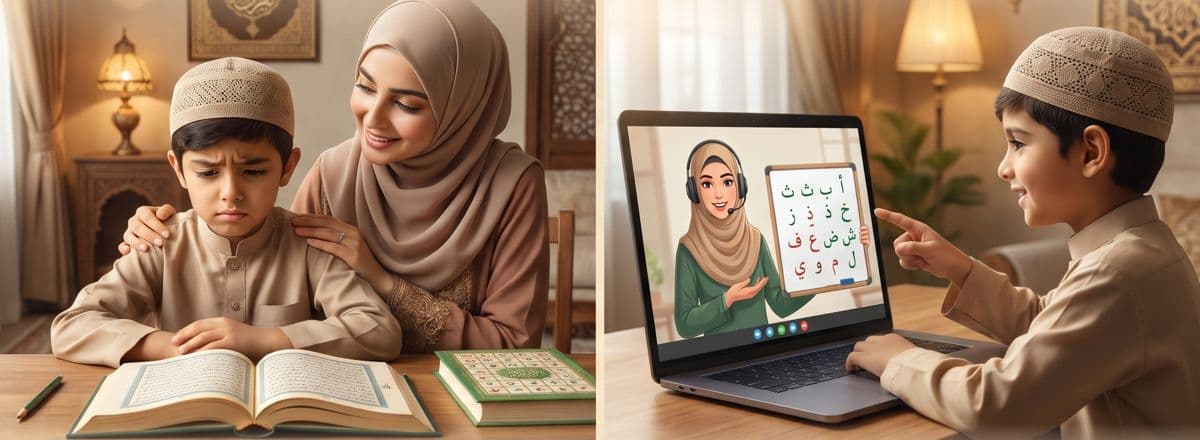
“The madrasah hall is loud, the routine keeps changing, and your child shuts down or melts down before the lesson even starts.”
“Ten minutes in, they're under the table. The teacher says “he just won't sit still”, and you've heard it before.”
“They loved listening to Quran at home — until Quran class became the hardest hour of the week.”
“You've tried two teachers already. You feel judged at the masjid door, and quietly wonder if you're doing something wrong.”
It isn’t your child. And it isn’t you. It’s the format.
A long, noisy group class asks every child to sit the same way for the same time. Change the format — quiet, short, one-to-one, the same routine every week — and many children who “couldn’t” start to read.
See it with your own child — before you pay anything
3 free 30-minute trial sessions, no card. Tell us what helps your child in the form and the tutor reads it before the first session.
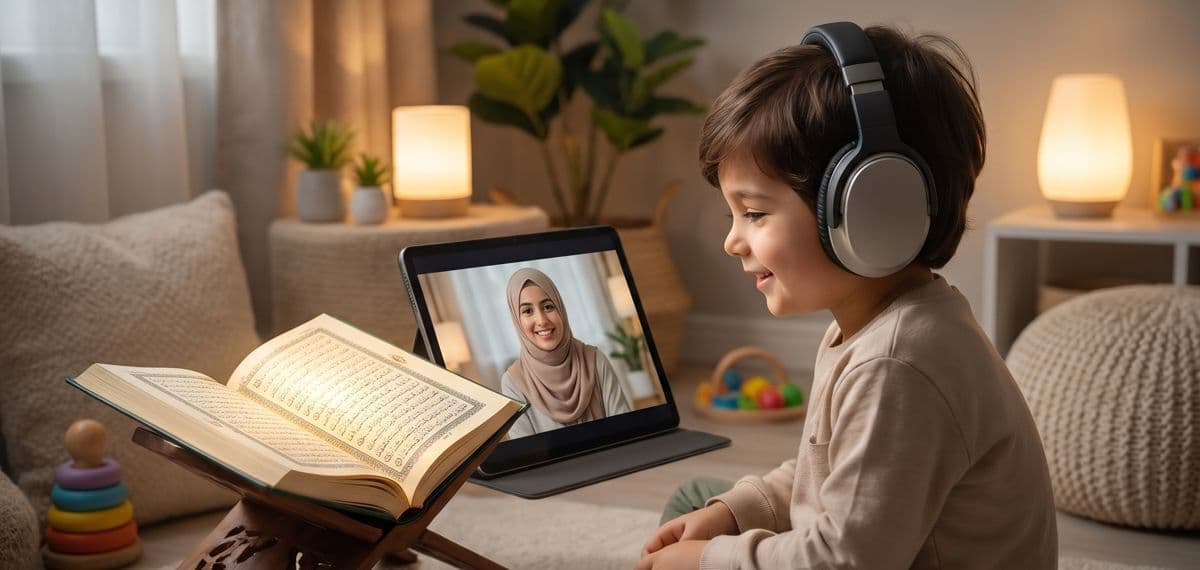
Parents of children with additional needs often tell the same story: the child loves hearing Quran at home but melts down, drifts off or goes silent in class. That is usually a mismatch of format, not of ability. A one-to-one online lesson removes the noise of a classroom, lets the session stop while your child is still calm, and lets the tutor repeat a letter as many times as needed without a queue of other students waiting. Detailed parent guides: how to teach Quran to an autistic child, how to teach Quran to a child with ADHD, how to teach Quran to a child with dyslexia and Quran learning with speech delay.
Why Standard Quran Classes Often Don’t Fit — and What Helps
Group classes ask every child to sit for the same length of time, at the same pace, with the same noise around them. Many children with additional needs can learn Quran well — just not in that format.
Short Focus Blocks
The shortest plan is 30 minutes, taught as short focused blocks with a break between them, so your child can stay regulated.
One Learner, One Tutor
No classmates, no waiting, no reciting in front of others. The tutor’s attention is on your child the whole time.
One Target at a Time
One letter, one harakah or one short ayah per session, reviewed until secure before moving on.
Parent-Briefed
You tell the tutor about triggers, communication style and what helps. Lessons follow that brief.
Safeguarding
Parents can sit in on every lesson. Male and female tutors are available.
Qualified Quran Teachers
Every NoorPath tutor holds an Ijazah or a Quran teaching certificate, and parents can ask to see it. We do not claim clinical or SEN qualifications.
How to Get Started — 3 Simple Steps
Tell us about your child
Age, diagnosis if any, what they find hard, what calms them, school or therapy strategies that work, and the time of day they are most settled.
Meet the tutor in free trial sessions
3 free 30-minute trial sessions. Watch how the tutor paces the lesson and responds to your child before deciding anything.
Same slot, same routine, five minutes at home
Short lessons at the same calm time each week, plus one tiny home task from the free printable kit on this page.
Comparing Learning Formats
| Method | Verdict | Why |
|---|---|---|
| 1-on-1 online tutor (NoorPath) | Paced to your child | Quiet, private, short sessions; the tutor can stop, repeat and adapt without a class waiting |
| Madrasah or masjid group class | Community, fixed pace | Valuable for belonging, but noise, long sitting and a shared pace can overwhelm some children |
| Apps and videos alone | Practice aid | Helpful for listening and letter recognition; nothing adapts or listens back |
| Specialist SEN tutor | Specialist support | Worth seeking if your child needs clinical-level support; NoorPath tutors are Quran teachers, not therapists |
How we teach autistic and ADHD children
Same Quran, same Noorani Qaida — a different way of delivering it. You brief the tutor before the first lesson on what helps and what to avoid, and the lessons follow that brief.
For autistic children
Predictable, quiet, no surprises
- Same opening, same order, every week. Salam, Bismillah, then the same lesson steps — so your child always knows what comes next.
- A heads-up before every change. “Two more letters, then a break.” Transitions are announced, never sudden.
- Quiet and low-stimulation. One tutor, one screen, no classroom noise. Headphones help, and you choose the room.
- Listen and echo first. Hearing and repeating a short phrase comes before reading, so Quran time starts with success.
- Clear, literal language. Short instructions, one at a time — no sarcasm, no long explanations.
- Their interests as motivation. Tell the tutor what your child loves; a favourite topic can become the reward.
- No unexpected touch. The lesson happens on a screen, so there is no physical prompting, no hand on the shoulder, no crowded room.
- A calm time slot. Pick the time your child is usually settled — for many, not straight after school or late in the evening.
For children with ADHD
Short, active, quick wins
- Short blocks with breaks between them. The lesson is split into short focused blocks, with a movement break in between.
- Move, then focus. Stretching, jumping or a quick game in the breaks — moving is allowed, not punished.
- Instant, specific praise. “You got ب perfectly!” straight away, not at the end of the lesson.
- One tiny target at a time. One letter or one harakah per block, so success comes fast and often.
- Variety inside the routine. The steps stay the same, but the activity changes — pointing, tracing, echoing, a letter hunt.
- First–then. “First this line, then your star.” A clear finish line makes starting easier.
- Hifz in tiny portions. One or two lines at a time: listen, repeat together, then repeat alone — and review before adding more.
Many children have both, or don’t have a diagnosis at all — the tutor mixes what works. NoorPath tutors are qualified Quran teachers, not therapists; keep clinical support with your child’s school or therapist.
What a 30-minute lesson looks like
An example plan. Your tutor adjusts the blocks and breaks to your child.
- 3 min — Salam & same opening
- 7 min — Block 1: one new letter
- 3 min — Movement break
- 7 min — Block 2: review + read
- 3 min — Game or calm break
- 5 min — Short surah by ear
- 2 min — Star & “next week”
Total: 30 minutes.
Progress you can actually see
For our children, progress isn’t “finished the Qaida by March”. It’s a calm start, then a full block, then a first letter. These are the milestones we track — every child moves through them at their own pace.
- Comes to the lesson calmlyQuran time stops being a battle.
- Stays for one full blockFocus builds a few minutes at a time.
- Knows the first lettersRecognises and says them with the tutor.
- Reads letters with harakatJoins sounds with fatha, kasra and damma.
- Recites Al-FatihaBy ear, from the page, or both — ready for salah.
Letters your child knows
Each letter is coloured in once it’s secure — 9 of 28 in this example.
Small wins, every week
One star per goal met — calm start, a full block, a new letter, a home task, a surah line.
Examples only, not a real student’s results. Enrolled families see their own child’s attendance, homework and teacher reports in the Parent Portal.
Can autistic and ADHD children memorise the Quran?
Yes — many do. News outlets in the UAE, Qatar and Malaysia have reported autistic children who memorised the whole Quran, and many autistic learners have a strong memory for sound and pattern. Children with ADHD often memorise well in short, lively bursts.
What we won’t do is promise you a timeline. Some children memorise quickly by ear and read slowly; others need months just to feel safe in a lesson. Both are progress. The goal is a child who loves Quran time — the memorising follows from that.
Every child starts somewhere
Tell us where your child is today. The tutor starts there — not where a textbook says they should be.
Free printable kit for home
The same tools our tutors use, for the days in between. Print it, stick it on the fridge, and keep Quran time predictable all week.
1. Visual lesson schedule
Cut out the cards and turn each one over when it’s done.
2. First → Then board
3. 5-minute home practice
| Mon | Listen to today's surah once and echo one line | ☆ |
| Tue | Trace this week's letter with a finger or crayon | ☆ |
| Wed | Letter hunt: find this week's letter on the Qaida page | ☆ |
| Thu | Read the week's letters to a parent or a favourite toy | ☆ |
| Fri | Recite at bedtime, then colour a star | ☆ |
4. Calm lesson setup checklist
- Same place and same time every week
- Headphones on, TV and other screens off
- Device on a stand, Qaida or Mushaf beside it
- Toilet, water and a snack before the lesson
- A fidget or squeeze toy is fine
- A parent within earshot
5. My letter star chart — colour a letter when you know it
Want to practise letters on screen? Try the free interactive Noorani Qaida — no account needed.
“What if my child won’t engage in the trial?”
It’s the most common worry we hear — and it’s exactly why there are three free sessions, not one. A gentle way to use them:
Just say hello
Your child can sit on your lap, wave, or watch from across the room. No reading is needed. Ask for this when you book.
One small try
Listening and echoing one short phrase, or pointing to one letter. If that's all, that's a win.
A short real lesson
A few minutes in the shape of a normal lesson, so you can see how the tutor paces your child.
A suggestion, not a fixed script — tell us what your child needs and the tutor follows it. If the tutor isn’t the right fit, ask for another one.
What gets lighter for you
You carry a lot already. This shouldn’t be one more fight.
You stop being teacher and referee
The tutor teaches. You sit nearby — or have a cup of tea.
No audience if it's a hard day
No waiting room, no stares. If your child needs to pause, the lesson pauses.
No guessing about progress
The Parent Portal shows attendance, homework and teacher reports for each lesson.
A tutor who fits your child
If you or your child are not comfortable with the tutor, NoorPath changes the tutor immediately.
No long contract
Cancel with 7 days' notice. Full refund if you ask within 7 days of the first paid class.
Nothing to lose by trying
3 free 30-minute trial sessions, no card needed. Watch the tutor with your child first.
“The one who is skilled in the Quran will be with the noble, righteous scribes, and the one who recites it with difficulty, stammering, will have a double reward.”
Every slow, hard-won letter your child reads counts — twice.
A dua for your child
رَبَّنَا هَبْ لَنَا مِنْ أَزْوَاجِنَا وَذُرِّيَّاتِنَا قُرَّةَ أَعْيُنٍ وَاجْعَلْنَا لِلْمُتَّقِينَ إِمَامًا
“Our Lord, grant us from our spouses and our children the coolness of our eyes, and make us leaders of the righteous.” (Al-Furqan 25:74)
The Prophet ﷺ named a parent’s supplication for their child among the prayers that are answered (Sunan Abi Dawud 1536).
You are not failing
“Allah does not burden a soul beyond that it can bear.” (Al-Baqarah 2:286)
That includes your child — and you. Bringing Quran into their life gently, at the pace they can manage, is not “less”. It is the job, done with mercy. For questions about what is required of your child, speak to a scholar you trust.
Before you book — four straight answers
- Who will teach my child?
- You meet the matched tutor in 3 free 30-minute trial sessions before paying anything. Every NoorPath tutor holds an Ijazah or a Quran teaching certificate, and parents can ask to see it.
- What if we miss a class?
- Give at least 24 hours' notice and the class can be moved, subject to tutor availability. Rescheduling is agreed directly with NoorPath.
- What if the tutor is not the right fit?
- If you or your child are not comfortable with the tutor, NoorPath changes the tutor immediately. Female tutors are available for sisters, daughters and young children.
- How do we stop?
- Cancel with 7 days' notice before the next billing date. No cancellation fee. Full refund if you ask within 7 days of your first paid class. After 7 days, fees already paid are not refunded.
Full wording in the Terms of Service and Safeguarding policy.
Available in Your Country
Frequently Asked Questions
Can children with autism, ADHD or dyslexia learn Quran online?
Many can. The format matters more than the label: short one-to-one sessions, one target at a time, a predictable routine and plenty of review usually work better than a long group class. Progress is individual, so NoorPath does not promise a timeline.
Are your tutors SEN specialists?
No. NoorPath tutors are qualified Quran teachers, not therapists or special-education clinicians. What we offer is the format — short, private, patient lessons — and a tutor who follows your brief. If your child needs clinical-level support, keep that with their school or therapist.
How long should each lesson be?
Many children with additional needs focus best in blocks of 10–20 minutes. The shortest NoorPath plan is 30 minutes, so tell us at booking if your child needs a movement or calm-down break inside the lesson.
How do you teach an autistic child the Quran?
With a predictable routine: the same opening and lesson order every week, a heads-up before each change, a quiet setting, clear short instructions and listening and echoing before reading. You brief the tutor on triggers and what helps, and the lessons follow that brief.
My child has ADHD. Isn't 30 minutes too long?
As one long stretch, often yes. That is why the lesson is split into short focused blocks with movement or game breaks in between, one tiny target per block and praise straight away. Tell us at booking how long your child can usually focus.
What happens if my child has a meltdown during the lesson?
The lesson pauses. Your child can take a break with you, come back when calm, or stop for the day — nobody is watching and there is no class waiting. Tell the tutor beforehand what helps your child regulate.
My child doesn't speak much. Can they still learn?
Many children who speak little still learn by listening, pointing to letters and memorising short surahs by ear. Talk to us about your child; the free trial sessions show whether the format suits them before you pay.
Can autistic or ADHD children memorise the Quran?
Yes, many do. News outlets in the UAE, Qatar and Malaysia have reported autistic children who memorised the whole Quran, and children with ADHD often memorise well in short, lively bursts. Pace is individual, so NoorPath does not promise a timeline — the first goal is a child who is calm and happy in Quran time.
What if my child won't talk or look at the screen in the trial?
That is common and it is fine. There are three free sessions so your child can warm up: the first can be just a hello, with your child on your lap or watching from across the room. Ask for this when you book.
Is there a dua for my autistic or ADHD child?
A dua from the Quran many parents make is “Rabbana hab lana min azwajina wa dhurriyyatina qurrata a‘yun waj‘alna lil-muttaqina imama” (Al-Furqan 25:74), asking Allah to make our children the coolness of our eyes. The Prophet ﷺ named a parent's supplication for their child among the prayers that are answered (Sunan Abi Dawud 1536).
Is my child sinful if they can't read or pray properly?
The Quran says Allah does not burden a soul beyond what it can bear (Al-Baqarah 2:286). How that applies to your child is a question for a scholar you trust. What we can do is make learning gentle and within your child's ability, so Quran becomes something they love.
Do we need a diagnosis?
No. Many families come to us before or without a diagnosis. Just tell us what you notice — for example that your child can't sit for long, gets overwhelmed by noise or freezes when asked to read.
Is there anything we can use at home?
Yes. This page has a free printable kit: a visual lesson schedule, a first–then board, a 5-minute home practice plan, a calm-setup checklist and a letter star chart.
Can I sit in on the lessons?
Yes. Parents are welcome to stay in the room, and many find it helps their child settle in the first weeks.
Can my child learn by listening if reading is very hard?
Yes. Memorising short surahs by ear can continue alongside slower reading practice, so your child stays connected to the Quran while reading skills develop.
What does it cost?
Published plans start at $29 per month for 4 30-minute one-to-one sessions, cancellable with 7 days' notice. 3 free 30-minute trial sessions are free with no credit card.
Quran Time Can Be Calm Again
Book free trial sessions, tell us what helps your child, and watch how the tutor teaches before deciding anything. If it isn’t right, you’ve lost nothing.
- ✓ 3 free 30-minute trial sessions — no credit card
- ✓ Short, private one-to-one lessons
- ✓ Parents welcome to sit in
- ✓ Male and female tutors available