Common Noorani Qaida Mistakes & How to Fix Them
Identify the 10 most common Noorani Qaida mistakes beginners make, from stretching short vowels to confusing makharij, and practical solutions to correct them.
Beginners learning Noorani Qaida frequently encounter ten predictable hurdles: stretching short vowels, bouncing non-Qalqalah consonants, confusing confusable dot families, and rushing doubled Shaddah letters. This guide pinpoints why these errors happen, explains easy verbal cues to fix them, and shows parents how patient modeling corrects habits before bad habits solidify.
How to use this guide
Every beginner student of Quranic Arabic makes mistakes; it is a natural part of training vocal cords to articulate sounds foreign to English phonetics. However, leaving recurring errors unaddressed allows muscle memory to solidify bad habits that become difficult to undo later. This troubleshooting guide catalogs the most common Noorani Qaida mistakes, explains their root causes, and offers simple practical fixes you can implement immediately.
Mistake 1 & 2: Vowel Stretching and Vowel Clipping
The most frequent error in beginner reading is stretching a solitary short vowel (Harakah) into a 2-count Madd, reading 'كَتَبَ' as 'كَتَابَا'. The opposite error is clipping a true Madd into a short vowel, reading 'قَالَ' as 'قَلَ'. Fix this by implementing a physical finger-tapping rule: single vowels get one quick tap, while Madd letters get two rhythmic finger taps.
- Short vowel = 1 beat (instant snap)
- Long vowel (Madd) = 2 beats (double duration)
- Never guess: look for the physical presence of Alif, Waw, or Yaa
- Use our Madd quiz to test duration sensitivity
Mistake 3 & 4: The Accidental Ghost Bounce on Sukoon
When stopping on consonants with Sukoon, students often bounce letters that should never bounce, saying 'Al-hamdu' as 'Al-a-hamdu'. Remember: Qalqalah (the bouncing echo) applies ONLY to five letters: Qaaf, Taa, Baa, Jeem, and Daal (ق ، ط ، ب ، ج ، د). All other letters must close their articulation point cleanly without an echo.
Mistake 5 & 6: Confusing Heavy vs Light Letter Pairs
Arabic contains pairs of letters that sound similar to foreigners but differ in heaviness (Tafkheem vs Tarqeeq): Seen (س) vs Saad (ص), Taa (ت) vs Taa-heavy (ط), Daal (د) vs Daad (ض). To fix this, train your child to raise the back of the tongue toward the soft palate for heavy letters, filling the oral cavity with a deep, authoritative sound.
Mistake 7 & 8: Skipping Tashdeed and Dropping Ghunnah
Rushing past a Shaddah (Tashdeed) drops a letter from the word. Children often read 'Inna' as 'Ina', skipping the mandatory two-count nasal hum (Ghunnah) on doubled Noon and Meem. Remind your child that a Shaddah represents two letters: press firmly into the sound and hold the nasal resonance for two slow counts.
See the learning approach
This screenshot documents NoorPath’s learning-platform experience. It is shown for educational and product context. Free playable browser games are linked below separately from the platform screenshots.
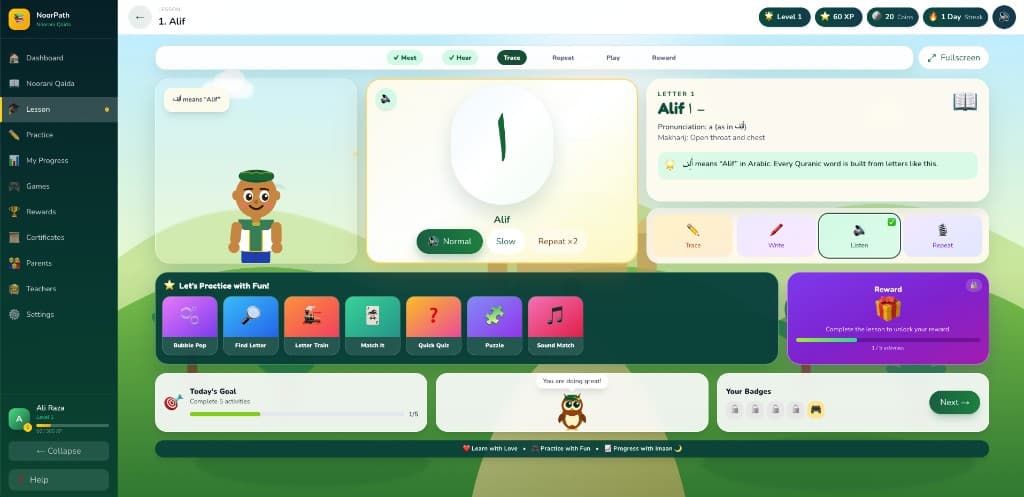
Common Noorani Qaida Mistakes & How to Fix Them checklist
Keep short vowels under 1 beat using finger-tap boundaries
Restrict Qalqalah bouncing strictly to Qutb Jad letters
Raise the back of the tongue for heavy consonants (Saad, Daad, Taa, Dhaa)
Hold mandatory 2-count Ghunnah on doubled Noon and Meem
Book a live teacher review to audit uncertain articulation points
Frequently asked questions
Why does my child keep stretching short vowels into long ones?
Children often stretch vowels when searching for the next letter in the word. Teach them to look ahead and decode silently before vocalizing aloud.
How can I fix my child's throat letter pronunciation at home?
Have them whisper a gentle sigh for Haa (ح) and softly imitate clearing the throat for Khaa (خ). For Ayn (ع), practice squeezing the middle throat muscles gently.
Is it normal for adults to make these same mistakes?
Absolutely. Adult revert and non-native learners face the identical phonetic habits. With patient 1-on-1 coaching, adults frequently correct them within a few weeks.
Core learning links
More Noorani Qaida Games & Worksheets
Reinforce Arabic reading skills between lessons. Explore our collection of free interactive browser games, phonics quizzes, and printable PDF worksheets designed for calm practice at home.
Arabic Letter Sound Quiz
Match Arabic letter shapes to correct pronunciation and makhraj sound cues.
Makharij Articulation Quiz
Test your knowledge of the 5 primary throat, tongue, and lip articulation points.
Arabic Harakat Quiz
Practise identifying Fatha, Kasra, and Damma on letters with instant feedback.
Arabic Letters Tracing Worksheet
Free printable handwriting practice for all 28 Arabic letters with stroke arrows.
Noorani Qaida Harakat Worksheet
Printable offline drills for short vowels, matching exercises, and reading practice.
Tanween Practice Quiz
Master double vowel endings (Fathatain, Kasratain, Dammatain) with fun rounds.
Practice with a live Noorani Qaida teacher — Book a free trial
Guides establish clarity. Pronunciation needs a trained teacher listening live. Book 3 free 30-minute 1-on-1 trial sessions with a patient, certified tutor in your timezone — no credit card needed.