Noorani Qaida Lesson Plan — Curriculum & Milestones
Complete Noorani Qaida lesson plan and milestone framework for parents and tutors. Detailed 11-module breakdown with timing, weekly goals, and checklists.
This structured Noorani Qaida lesson plan provides an eleven-module curriculum roadmap spanning single letters, Harakat, Tanween, Sukoon, Shaddah, and word blending. Each stage includes estimated lesson counts, mastery milestones, and revision intervals. Use this syllabus to track your child's weekly reading progress systematically without rushing or leaving foundational gaps.
How to use this guide
A successful Quranic reading journey requires a deliberate syllabus. Many students struggle or lose motivation because parents or tutors rush through early pages too quickly, only to hit a wall when letters join into long words. This comprehensive Noorani Qaida lesson plan breaks the entire curriculum into 11 manageable modules with explicit mastery milestones, ensuring steady progress and zero foundational gaps.
The 11-Module Noorani Qaida Curriculum Roadmap
The classical Noorani Qaida curriculum is structured in a logical phonetic hierarchy. Module 1 covers single isolated letters. Module 2 introduces joining forms and compound letters (Murakkabaat). Modules 3, 4, and 5 cover short vowels (Harakat), standing vowels, and Tanween. Modules 6 and 7 introduce Sukoon and Jazm exercises. Modules 8, 9, 10, and 11 cover Tashdeed (Shaddah), Madd elongation rules, and continuous Quranic phrase reading.
- Modules 1–2: Alphabet recognition and cursive letter connections
- Modules 3–5: Short vowels (Harakat) and double vowels (Tanween)
- Modules 6–7: Sukoon (still consonants) and Qalqalah bouncing rules
- Modules 8–9: Tashdeed (doubled letters) and Ghunnah nasalization
- Modules 10–11: Long vowels (Madd) and continuous sentence reading
Realistic Timelines and Pace Expectations by Age
For ages 4 to 6, completing the full Qaida typically takes 6 to 9 months with 3 to 4 weekly lessons of 20 to 30 minutes. For ages 7 to 12, completion usually takes 4 to 6 months. Never rush a child past a module until they can decode lines smoothly without guessing. Moving forward with unstable vowels often leads to frustration when reading multi-syllable verses.
Weekly Mastery Milestones and Checkpoints
At the end of each week, conduct a calm two-minute milestone check. Test five random examples from the current lesson mixed with two examples from past weeks. If the child hesitates on more than two items, dedicate the next session to revision before advancing.
Integrating Interactive Quizzes and Printable Worksheets
Supplement each textbook lesson with multimodal practice: assign our free printable worksheets for handwriting muscle memory, and play a matching or Harakat quiz on a phone to evaluate quick mental recall between formal classes.
See the learning approach
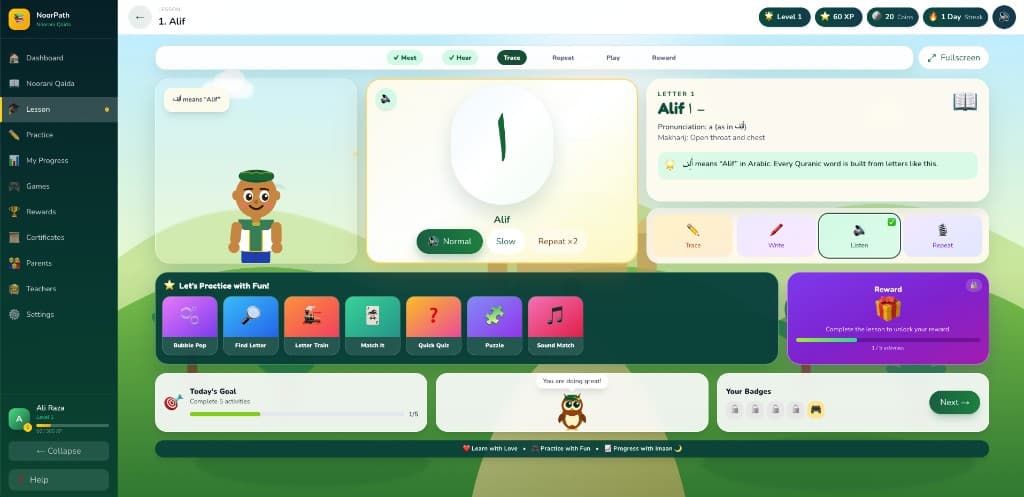
This screenshot documents NoorPath’s learning-platform experience. It is shown for educational and product context. Free playable browser games are linked below separately from the platform screenshots.
Noorani Qaida Lesson Plan — Curriculum & Milestones checklist
Establish 3 to 4 weekly lesson slots of 25 minutes
Do not advance past single letters until all 28 sounds are known
Conduct weekly 2-minute milestone checks
Combine textbook reading with printable tracing worksheets
Review past modules every Friday to cement long-term retention
Frequently asked questions
How many lessons are in a standard Noorani Qaida course?
A full course typically spans 50 to 70 individual 30-minute lessons, depending on the child's age, baseline language skills, and weekly practice regularity.
What is the hardest module for children in Noorani Qaida?
Most children find Module 2 (Joining Letters) and Module 8 (Shaddah with Sukoon) the most challenging. Spend extra time reinforcing these two turning points.
How do I know when my child is ready to graduate to the Quran?
When your child can open an unfamiliar page of Juz Amma and decode three lines of text independently with correct vowels and stopping rules.
Core learning links
More Noorani Qaida Games & Worksheets
Reinforce Arabic reading skills between lessons. Explore our collection of free interactive browser games, phonics quizzes, and printable PDF worksheets designed for calm practice at home.
Arabic Letter Sound Quiz
Match Arabic letter shapes to correct pronunciation and makhraj sound cues.
Makharij Articulation Quiz
Test your knowledge of the 5 primary throat, tongue, and lip articulation points.
Arabic Harakat Quiz
Practise identifying Fatha, Kasra, and Damma on letters with instant feedback.
Arabic Letters Tracing Worksheet
Free printable handwriting practice for all 28 Arabic letters with stroke arrows.
Noorani Qaida Harakat Worksheet
Printable offline drills for short vowels, matching exercises, and reading practice.
Tanween Practice Quiz
Master double vowel endings (Fathatain, Kasratain, Dammatain) with fun rounds.
Practice with a live Noorani Qaida teacher — Book a free trial
Guides establish clarity. Pronunciation needs a trained teacher listening live. Book 3 free 30-minute 1-on-1 trial sessions with a patient, certified tutor in your timezone — no credit card needed.