How to Teach Noorani Qaida at Home — Parent Guide
How to teach Noorani Qaida at home with a calm routine: the right lesson order, gentle mistake correction and short daily practice habits for kids.
Teaching Noorani Qaida at home requires a consistent, gentle routine prioritizing recognition before pronunciation. Parents should model sounds once, guide short five-minute practice sessions, and avoid testing unlearned letters. This guide outlines step-by-step teaching methods, distraction management, and when to involve a qualified Quran teacher to correct subtle makharij mistakes safely.
How to use this guide
Teaching your child Noorani Qaida at home can feel intimidating, especially if you are not an Arabic native speaker or fear entrenching incorrect pronunciation habits. The secret to successful home instruction is realizing that your primary role as a parent is not to act as a strict examiner, but to create a calm, repeatable learning environment. By focusing on short daily lessons, pairing visual recognition with auditory models, and addressing mistakes with patience, you can guide your child through the Arabic alphabet, Harakat, and word blending with confidence.
The Three-Phase Teaching Framework: Model, Guide, Release
Never ask a child to read a new Arabic letter or vowel mark before you have modeled it clearly. The 'Model, Guide, Release' framework consists of three gentle steps: (1) Model: point to the letter and articulate its sound cleanly while the child simply listens and looks. (2) Guide: pronounce the sound together with the child, highlighting physical mouth cues. (3) Release: let the child tap and vocalize the sound independently. This gradual progression eliminates performance anxiety.
- Phase 1 (Model): Parent models the sound while child listens without pressure
- Phase 2 (Guide): Parent and child say the sound in unison while pointing
- Phase 3 (Release): Child points and articulates sound independently
- Always stop before frustration or fatigue sets in
Establishing a Calm Ten-Minute Daily Routine
Young children learn language through frequency, not endurance marathons. A focused 10-minute session held five days a week is vastly superior to a stressful 45-minute weekend struggle. Structure the ten minutes intentionally: 2 minutes reviewing yesterday's known letter, 5 minutes introducing one single new concept, and 3 minutes playing a free interactive quiz or tracing game.
How to Correct Mistakes Without Crushing Motivation
When your child makes a pronunciation error, avoid saying 'No, that is wrong!' Instead, reflect the correct sound naturally: 'Ah, you noticed the dots! That one sounds like Seen—listen closely: Sss.' Praise effort, focus, and careful looking rather than demanding flawless native accent immediately. Subtle makharij precision develops gradually through physical maturity and teacher guidance.
When to Involve a Certified Quran Teacher
While parents excel at reinforcing letter recognition and daily homework, certain Arabic throat letters (ع ، ح ، خ) and emphatic consonants (ص ، ض ، ط ، ظ) require a trained human ear to calibrate accurately. Booking a live 1-on-1 trial with a certified Quran tutor ensures your child receives professional feedback on subtle articulation before moving into full Quranic verses.
See the learning approach
This screenshot documents NoorPath’s learning-platform experience. It is shown for educational and product context. Free playable browser games are linked below separately from the platform screenshots.
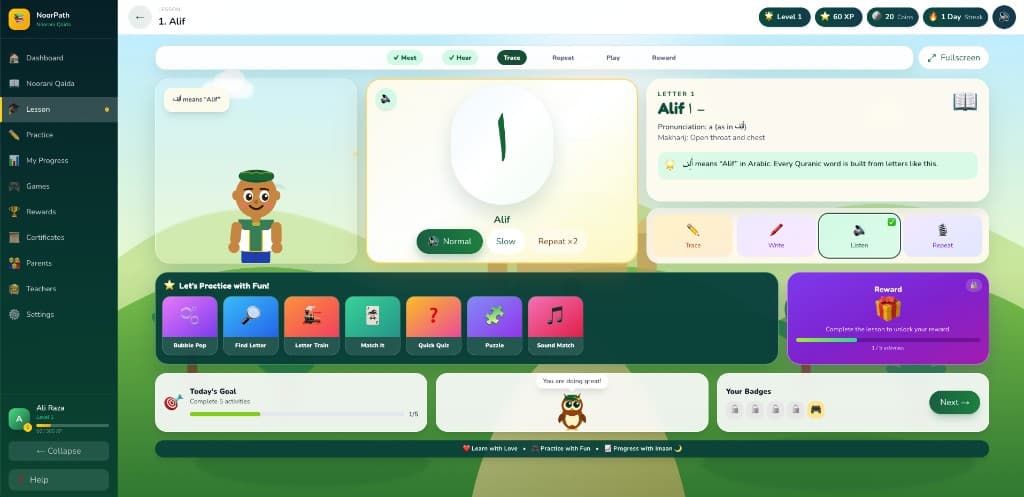
How to Teach Noorani Qaida at Home — Parent Guide checklist
Keep daily practice under 10 minutes
Model sounds clearly before asking the child to speak
Praise looking and listening effort rather than instant perfection
Use free interactive games for low-stress retrieval practice
Schedule a live teacher assessment for throat and emphatic letters
Frequently asked questions
Can I teach my child Noorani Qaida if I am not fluent in Arabic?
Yes! You can manage visual recognition, letter forms, and daily routine at home while pairing with approved audio models and booking a live online tutor for pronunciation checks.
What is the best age to start Noorani Qaida at home?
Most children can start gentle letter recognition games around ages 4 to 5. Formal blending and vowel lessons usually thrive between ages 5 and 7.
How long should a beginner lesson last?
Keep sessions between 7 and 10 minutes for ages 4 to 6, and 12 to 15 minutes for older children. Consistency across 5 days beats one long weekend drill.
Core learning links
More Noorani Qaida Games & Worksheets
Reinforce Arabic reading skills between lessons. Explore our collection of free interactive browser games, phonics quizzes, and printable PDF worksheets designed for calm practice at home.
Arabic Letter Sound Quiz
Match Arabic letter shapes to correct pronunciation and makhraj sound cues.
Makharij Articulation Quiz
Test your knowledge of the 5 primary throat, tongue, and lip articulation points.
Arabic Harakat Quiz
Practise identifying Fatha, Kasra, and Damma on letters with instant feedback.
Arabic Letters Tracing Worksheet
Free printable handwriting practice for all 28 Arabic letters with stroke arrows.
Noorani Qaida Harakat Worksheet
Printable offline drills for short vowels, matching exercises, and reading practice.
Tanween Practice Quiz
Master double vowel endings (Fathatain, Kasratain, Dammatain) with fun rounds.
Practice with a live Noorani Qaida teacher — Book a free trial
Guides establish clarity. Pronunciation needs a trained teacher listening live. Book 3 free 30-minute 1-on-1 trial sessions with a patient, certified tutor in your timezone — no credit card needed.