Free Noorani Qaida with Animation for Kids
Learn what Noorani Qaida with animation should mean for kids: visual lessons, purposeful motion, and NoorPath’s preview video plus interactive letter practice.
How to use this guide
Parents searching for Noorani Qaida with animation usually want one thing: a child who stays engaged long enough to learn Arabic letters without melting down or guessing. “Animation” in marketing can mean anything from a short lesson preview video to a full cartoon series. Enterprise-quality guidance starts by separating motion that teaches from motion that only entertains. A useful animated or visual Qaida experience helps the learner notice shape, dots, joining forms, and short vowels. It does not replace a clear curriculum sequence or a teacher who can hear uncertain sounds. NoorPath’s public interactive hub explains an 11-module path with platform preview screenshots and a short lesson preview video, plus free browser recognition games. That is visual and interactive support — not a claim that every letter ships as a standalone cartoon episode. This guide explains how to evaluate animation claims honestly, what to look for before you enrol, and how to combine visual practice with live correction. Families in diaspora settings especially benefit from tools that work on a phone after school, keep Arabic visible, and connect to a live tutor when sounds remain uncertain. Take ten minutes to inspect the curriculum map, try one recognition activity, and write down one question for a teacher before paying for any long package. That habit protects attention, money, and trust. Return to the Interactive Noorani Qaida hub whenever you need the full module list, letter index, or links to free games. Keep commercial class booking on the trial and pricing pages so practice tools stay uncluttered. If a claim on any site cannot be demonstrated in a short trial session or a visible public page, treat it as unfinished product work rather than a reason to enrol immediately. Share useful free practice links with another parent only when the resource is genuinely calm and accurate. Over time, small honest routines outperform dramatic marketing promises, especially for beginners building Arabic letter confidence before full Quran pages.
What parents usually mean by animated Qaida
When families type “Noorani Qaida with animation,” they often mix three different needs. First is attention: young children struggle with static worksheets. Second is clarity: Arabic letters change shape when they join, so seeing forms move or highlight can reduce confusion. Third is motivation: stars, short scenes, or playful transitions make practice feel lighter. Only the first two needs are strictly educational. Motivation tools help when they reinforce a clear skill; they harm when the child remembers the cartoon but not the letter. Ask any provider which skill a clip or animation is meant to teach — recognition, joining, or a vowel mark — before treating motion as proof of a complete course.
Digital visual lessons versus cartoon entertainment
A digital visual lesson shows the Arabic glyph, naming cue, and often a joining sequence or tracing path. Motion is purposeful: highlight the target, reveal a form, or replay a short step. Cartoon entertainment may be delightful and still fail to build decoding. Children can love a character and still guess words from memory. Prefer tools that keep Arabic on screen while any motion happens, that pause for the child to respond, and that allow parents to repeat one letter without restarting a long story. If a product markets “full animation” but cannot show a simple Alif or Baa lesson structure, treat the claim as incomplete.
- Arabic stays visible during the activity
- One learning target per short segment
- Replay without forcing a whole episode
- Parent can see what was practised
What to look for before you trust an animation claim
Check curriculum transparency: are all 28 letters and early Harakaat mapped, or only a trailer? Check honesty about audio: motion without a reliable sound model still needs teacher or approved recording support. Check whether rewards lock content — locking teaches children to chase unlocks, not mastery. Check device reality: many “apps” are store listings; a web hub that works on a phone may fit diaspora families better. Finally, check the correction path. Visual practice without someone who can hear ع or ق will eventually stall. Animation should sit beside modelling and feedback, not replace them.
How NoorPath approaches visual and animated learning today
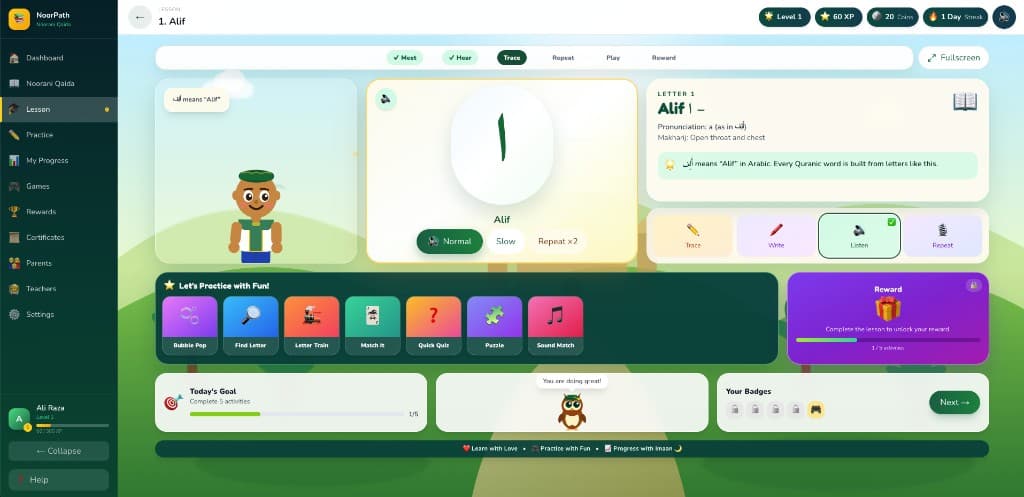
NoorPath publishes an Interactive Noorani Qaida hub that documents an 11-module journey from Arabic alphabets through Harakaat, joining, word reading, and revision. Public pages include platform-preview screenshots of focused letter lessons and practice activities, plus a short marketing preview video of the lesson interface. On this website, children can also use free browser games for letter matching and harakat recognition. Letter reference pages include a find-the-letter practice widget. These are real, shipped experiences. What NoorPath does not claim on public pages is a complete public cartoon series for every letter or Qari-reviewed audio tied to every animation frame. Live one-to-one classes remain the path for pronunciation correction. That separation is intentional: visual practice supports recognition; teachers verify sounds.
A calm home routine that uses visual practice well
Keep sessions short. Open one letter page or one game round after a known success. Ask the child to point before speaking. If you use the platform preview or screenshots, narrate what you want them to notice — dots, bowl shape, or vowel mark — rather than letting them tap randomly. End while attention is still positive. Two or three focused minutes of visual recognition often beat a long animated binge. Pair weekend visual practice with weekday live lessons when possible so uncertain sounds are caught early. Use the free games hub when you need retrieval without opening a full lesson UI.
When animation is not enough
Move beyond visual-only practice when the child confuses similar letters in joined text, stretches short vowels into Madd, or avoids hard throat letters. Those issues need listening and correction. Animation can still warm up recognition, but the next step is a tutor who hears the child. Families comparing products should ask for a trial lesson that starts at the child’s real level — not a generic animated trailer. NoorPath’s free trial for live classes is arranged separately from the interactive reference hub.
A one-week action plan parents can follow
Day one: open the Interactive Noorani Qaida hub and note the module that matches your child. Day two: run a five-minute recognition session on one letter or vowel using a letter page or free game. Day three: ask your child to teach you one form difference they noticed. Day four: repeat yesterday’s target and add one contrast letter. Day five: if sounds feel uncertain, request a free live trial or message the tutor with specific letters. Weekend: light review only — one favourite letter and one known success. Write observations in a shared note so adults stay aligned. This rhythm builds evidence without turning the week into a performance. Adjust timing for your timezone and school load, and keep devices in a family space for younger children. If motivation drops, shorten the session rather than adding louder entertainment. Progress in beginner Quranic Arabic is usually quiet and cumulative; protect that quiet with clear targets and honest tools.
See the learning approach
This screenshot documents NoorPath’s learning-platform experience. It is shown for educational and product context. Free playable browser games are linked below separately from the platform screenshots.
Free Noorani Qaida with Animation for Kids checklist
Name the skill the animation or visual clip is meant to teach
Confirm Arabic stays on screen during motion
Prefer short replayable segments over long cartoons
Use NoorPath letter pages or games for recognition practice
Book live correction for uncertain sounds
Frequently asked questions
Does NoorPath offer a full animated Noorani Qaida cartoon for every letter?
No. Public pages provide an interactive curriculum hub, platform preview screenshots and video, letter practice widgets, and free browser games. They do not claim a complete public cartoon episode library for all 28 letters.
Is Noorani Qaida with animation enough without a teacher?
Visual practice can strengthen recognition and attention, but uncertain pronunciation still needs an approved model or live teacher. Animation should support — not replace — correction.
Where should I start if my child only responds to screens?
Begin with short recognition games or one letter page, keep sessions under five focused minutes, and add a live trial when you need sound correction. Avoid long entertainment-only videos that hide the Arabic.
Continue exploring
Want guided Noorani Qaida lessons?
Explore live one-to-one classes for ages 4+, with tutor matching based on learner needs, timezone, and availability.