Online Arabic Alphabet Practice for Kids
Online Arabic alphabet practice for kids: recognition-first routines, 28 NoorPath letter pages, find-the-letter practice, and free matching games on mobile.
How to use this guide
Online Arabic alphabet practice works when it mirrors how reading actually develops: see the letter, name what makes it unique, then produce the sound with a reliable model. Many children fail not because they lack intelligence, but because practice jumps straight to saying every letter while shapes are still fuzzy. This guide gives a calm online practice system for the 28 Arabic letters, explains how NoorPath’s letter pages and free games support that system, and shows parents what to skip. You do not need to become a Qari at home. You need a routine that protects attention and feeds clear questions to a teacher. Families in diaspora settings especially benefit from tools that work on a phone after school, keep Arabic visible, and connect to a live tutor when sounds remain uncertain. Take ten minutes to inspect the curriculum map, try one recognition activity, and write down one question for a teacher before paying for any long package. That habit protects attention, money, and trust. Return to the Interactive Noorani Qaida hub whenever you need the full module list, letter index, or links to free games. Keep commercial class booking on the trial and pricing pages so practice tools stay uncluttered. If a claim on any site cannot be demonstrated in a short trial session or a visible public page, treat it as unfinished product work rather than a reason to enrol immediately. Share useful free practice links with another parent only when the resource is genuinely calm and accurate. Over time, small honest routines outperform dramatic marketing promises, especially for beginners building Arabic letter confidence before full Quran pages. Families often ask whether alphabet practice should start with isolated shapes or joined forms. Begin with clear isolated recognition, then introduce joining once the child can find the letter among distractors. Avoid racing through all twenty-eight letters in one sitting; three careful letters with form awareness beat a full chart skim. If your child already knows some letter names from nursery songs, test reading with vowels before assuming mastery. Keep a short list of confused pairs — such as ب/ت/ث or ج/ح/خ — and revisit them across the week. When practice feels stuck, switch to a different modality: pointing on a letter page, one matching round, then a quiet write-and-show. Consistency matters more than novelty. Share the same target with anyone helping at home so adults do not contradict each other on names or forms.
Recognition before production
Ask the child to point to the target letter among two familiar distractors before asking for the sound. Pointing isolates visual understanding. Production can wait until the eyes are stable. This order reduces tears and guessing. Online, that means large glyphs, clear dots, and buttons big enough for small fingers. NoorPath letter pages show isolated, initial, medial, and final teaching forms so children see how a letter changes when it joins — a core alphabet skill often missing from flashcard-only apps.
Practise letter families and contrast pairs
Arabic letters cluster visually: Baa, Taa, Thaa share a bowl and differ by dots; Seen and Saad differ by emphasis and shape; Qaaf and Kaaf differ in depth. Online practice should deliberately compare confusable pairs rather than racing A to Yaa in order every day. Spend two minutes on one contrast. Celebrate correct pointing even before perfect pronunciation. Teachers can assign the week’s contrast; parents should not invent new pairs that conflict with the tutor’s sequence.
What NoorPath provides for alphabet practice
The Interactive Noorani Qaida hub includes a full index of 28 Arabic letter guides. Each page covers forms, articulation cues, examples, common confusions, parent and teacher tips, and a find-the-letter interactive practice widget. The free letter matching game on the games hub strengthens name-to-glyph mapping on a phone. These tools are recognition and reference supports. They do not claim automated pronunciation scoring or a complete offline download pack. Live classes remain available when you want guided correction.
- 28 letter pages under /noorani-qaida/arabic-letters/
- Find-the-letter practice on each letter page
- Free letter matching game
- Hub alphabet grid for open navigation
A five-minute online alphabet routine
Minute one: review yesterday’s letter with a quick find round. Minutes two and three: one new or weak letter — look at forms, then play matching or find-the-letter. Minute four: one contrast with a similar letter. Minute five: child chooses a known favourite letter to end on success. Stop early if tension rises. Consistency across most days beats weekend marathons. Keep the device in a shared space for young children.
Common alphabet practice mistakes online
Racing the whole alphabet daily without mastery. Correcting every sound as a parent without a model. Using English spellings as if they were Arabic. Practising only isolated forms and then panicking when letters join. Letting games run without naming the target. Fix these by narrowing the session, following the teacher’s letter order, and using transliteration only as a temporary label.
When to move from alphabet to vowels and joining
When the child usually finds letters among nearby distractors and can name dots calmly, add Fatha, Kasra, and Damma lessons, then joining. Do not wait for perfect makharij on every letter before introducing short vowels — but do not skip hard letters forever either. Use the harakat quiz after vowel lessons begin. Ask your tutor for a readiness check before jumping to Quran pages.
A one-week action plan parents can follow
Day one: open the Interactive Noorani Qaida hub and note the module that matches your child. Day two: run a five-minute recognition session on one letter or vowel using a letter page or free game. Day three: ask your child to teach you one form difference they noticed. Day four: repeat yesterday’s target and add one contrast letter. Day five: if sounds feel uncertain, request a free live trial or message the tutor with specific letters. Weekend: light review only — one favourite letter and one known success. Write observations in a shared note so adults stay aligned. This rhythm builds evidence without turning the week into a performance. Adjust timing for your timezone and school load, and keep devices in a family space for younger children. If motivation drops, shorten the session rather than adding louder entertainment. Progress in beginner Quranic Arabic is usually quiet and cumulative; protect that quiet with clear targets and honest tools.
See the learning approach
This screenshot documents NoorPath’s learning-platform experience. It is shown for educational and product context. Free playable browser games are linked below separately from the platform screenshots.
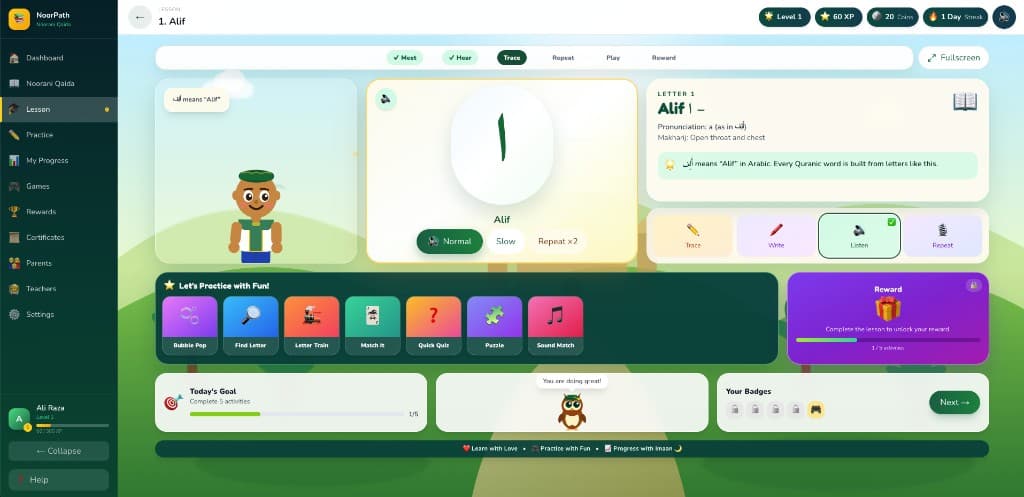
Online Arabic Alphabet Practice for Kids checklist
Point before speaking
Practise one contrast pair per session
Use letter pages for forms and tips
Add the free matching game for recall
Send uncertain sounds to the teacher
Frequently asked questions
How can kids practise the Arabic alphabet online effectively at home?
Use short recognition-first routines: point to the letter, compare one similar letter, then add a small game round. Follow a tutor’s sequence and keep sessions around five focused minutes for young children.
Does NoorPath include all 28 Arabic letters for online practice?
Yes. The Noorani Qaida hub links to a complete set of 28 letter reference pages with forms, tips, and a find-the-letter practice widget, plus a free letter matching game.
Should parents correct every Arabic letter sound during online practice?
Correct only what a teacher or approved model has clearly shown. Note uncertain sounds for the next lesson instead of reinforcing a guessed pronunciation.
Continue exploring
Want guided Noorani Qaida lessons?
Explore live one-to-one classes for ages 4+, with tutor matching based on learner needs, timezone, and availability.