Noorani Qaida with Audio — Parent Guide
Noorani Qaida with audio—honest guidance: evaluate recordings, avoid guessed sounds, and see what NoorPath offers before a full Qari-reviewed library ships.
How to use this guide
“Noorani Qaida with audio” is one of the most searched — and most oversold — phrases in beginner Quran education. Parents want a trustworthy sound model their child can replay. That need is real. What is not always real is the product behind the phrase. Some sites imply Qari-reviewed tracks for every letter when assets are incomplete, automated, or unverified. NoorPath’s public position is deliberately careful: live teachers remain the correction path for uncertain sounds, and public pages do not claim a completed Qari-reviewed downloadable audio library. This guide teaches you how to evaluate any audio resource, how to practise listen-and-repeat without harm, and what NoorPath actually provides today — including the pronunciation guide, interactive hub, and free trial classes — without marketing a feature that is not yet shipped as a public reviewed library. Families in diaspora settings especially benefit from tools that work on a phone after school, keep Arabic visible, and connect to a live tutor when sounds remain uncertain. Take ten minutes to inspect the curriculum map, try one recognition activity, and write down one question for a teacher before paying for any long package. That habit protects attention, money, and trust. Return to the Interactive Noorani Qaida hub whenever you need the full module list, letter index, or links to free games. Keep commercial class booking on the trial and pricing pages so practice tools stay uncluttered. If a claim on any site cannot be demonstrated in a short trial session or a visible public page, treat it as unfinished product work rather than a reason to enrol immediately. Share useful free practice links with another parent only when the resource is genuinely calm and accurate. Over time, small honest routines outperform dramatic marketing promises, especially for beginners building Arabic letter confidence before full Quran pages. Until a public Qari-reviewed library ships, treat any third-party recording as temporary scaffolding, not a final standard. Prefer sources you can pause, replay once, and match to a visible Arabic letter. Avoid autoplay loops that train guessing. If a recording disagrees with your tutor, follow the tutor and note the conflict. Parents should also protect younger listeners from unvetted YouTube playlists marketed as “perfect Tajweed for toddlers.” Short, known models plus live feedback remain safer than long anonymous catalogues. When NoorPath publishes reviewed tracks, public copy and academy facts should update together so marketing and product stay aligned.
Why audio matters for Noorani Qaida
Arabic has sounds English does not share. Transliteration cannot carry ع, ح, ق, or emphatic letters accurately. Children need to hear a stable model, then attempt, then receive correction. Audio supports the first two steps. It cannot fully replace the third when the learner’s attempt is wrong in a subtle way. Treat audio as a model and memory aid, not as an automatic examiner.
How to evaluate Noorani Qaida audio resources
Ask who recorded the audio and whether review is documented. Prefer clear letter-by-letter or rule-by-rule tracks over music-heavy apps that bury the glyph. Check whether the recording matches the written lesson order your tutor uses. Avoid unknown file shares that may be unlicensed or mistyped. If a site claims “Qari-reviewed” without explaining what was reviewed, ask for specifics. Honest providers disclose pending review rather than inventing status.
- Known source or teacher recommendation
- Arabic text visible while listening
- Short replayable segments
- Clear review or “pending review” disclosure
Product gap: NoorPath’s public audio library status
As of this writing, NoorPath does not publish a complete public Qari-reviewed Noorani Qaida audio download pack on noorpath.online. The pronunciation guide and related pages state that public copy must not claim reviewed recordings until specific assets complete formal review. Platform materials may describe listen-and-repeat guidance inside the learning product context, but families should not assume every public page ships graded audio files. This is a product gap to close with reviewed assets, listen UI, and updated disclosures — not something to paper over with marketing language. Until that ships, use live lessons and teacher-approved models for sound accuracy.
Safe listen-and-repeat practice at home
Play one short model. Ask the child to look at the Arabic first. Allow one or two attempts. Stop if the child strains or invents a sound. Record which letter felt uncertain and send it to the tutor. Do not chain twenty new sounds in one sitting. Pair audio days with recognition games so visual memory stays strong even when you pause production.
Where NoorPath helps while audio assets mature
Use the Interactive Noorani Qaida hub for letter forms, articulation cues, and practice structure. Use the pronunciation guide for responsible transliteration and mouth-cue guidance. Use free recognition games between lessons. Request a free live trial when you need a human ear. That stack is honest and useful without pretending a full reviewed audio catalogue exists on the marketing site today.
Questions to ask any academy about audio
Is audio Qari-reviewed, teacher-recorded, or synthetic? Can we hear the same tutor in the trial who will teach ongoing lessons? Are tracks aligned to your Qaida sequence? What happens when the child still mispronounces after listening? Clear answers matter more than a glossy “with audio” badge.
A one-week action plan parents can follow
Day one: open the Interactive Noorani Qaida hub and note the module that matches your child. Day two: run a five-minute recognition session on one letter or vowel using a letter page or free game. Day three: ask your child to teach you one form difference they noticed. Day four: repeat yesterday’s target and add one contrast letter. Day five: if sounds feel uncertain, request a free live trial or message the tutor with specific letters. Weekend: light review only — one favourite letter and one known success. Write observations in a shared note so adults stay aligned. This rhythm builds evidence without turning the week into a performance. Adjust timing for your timezone and school load, and keep devices in a family space for younger children. If motivation drops, shorten the session rather than adding louder entertainment. Progress in beginner Quranic Arabic is usually quiet and cumulative; protect that quiet with clear targets and honest tools.
See the learning approach
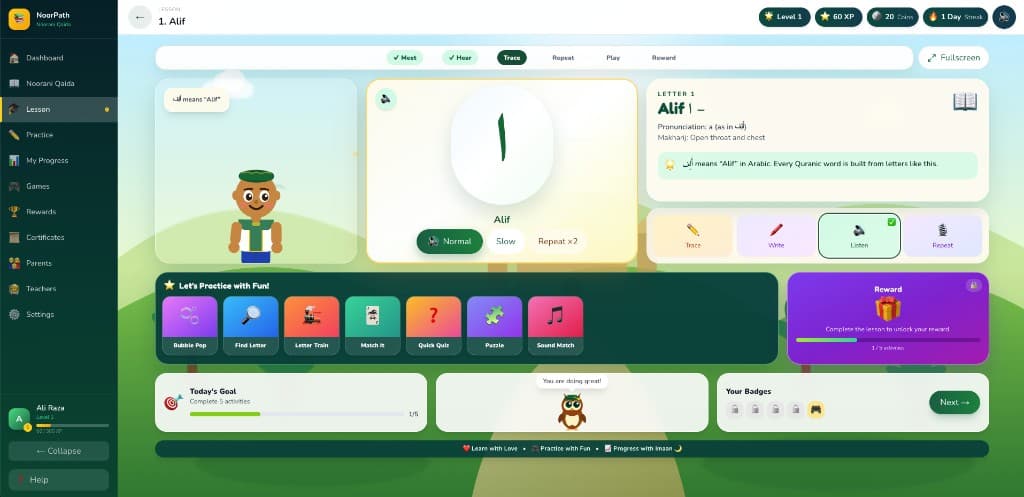
This screenshot documents NoorPath’s learning-platform experience. It is shown for educational and product context. Free playable browser games are linked below separately from the platform screenshots.
Noorani Qaida with Audio — Parent Guide checklist
Look at Arabic before listening
Use short models and few attempts
Do not assume unverified “Qari-reviewed” claims
Note uncertain sounds for the teacher
Use NoorPath’s pronunciation guide and live trial for correction
Frequently asked questions
Does NoorPath offer downloadable Qari-reviewed Noorani Qaida audio for every letter?
No. Public pages do not currently claim a complete Qari-reviewed audio library. Live teachers and approved models remain the correction path until reviewed assets are published with clear disclosure.
How should parents use Noorani Qaida with audio when local teachers are limited?
Choose a clear, reputable model or live online tutor, keep listen-and-repeat short, watch the Arabic while listening, and avoid reinforcing guessed sounds. Online trials can supply human correction across timezones.
Is app speech recognition enough to replace a Quran teacher’s ear?
No. Automated tools may flag possible differences but should not be treated as final proof of articulation. A qualified teacher remains important for uncertain letters and Tajweed.
Continue exploring
Want guided Noorani Qaida lessons?
Explore live one-to-one classes for ages 4+, with tutor matching based on learner needs, timezone, and availability.